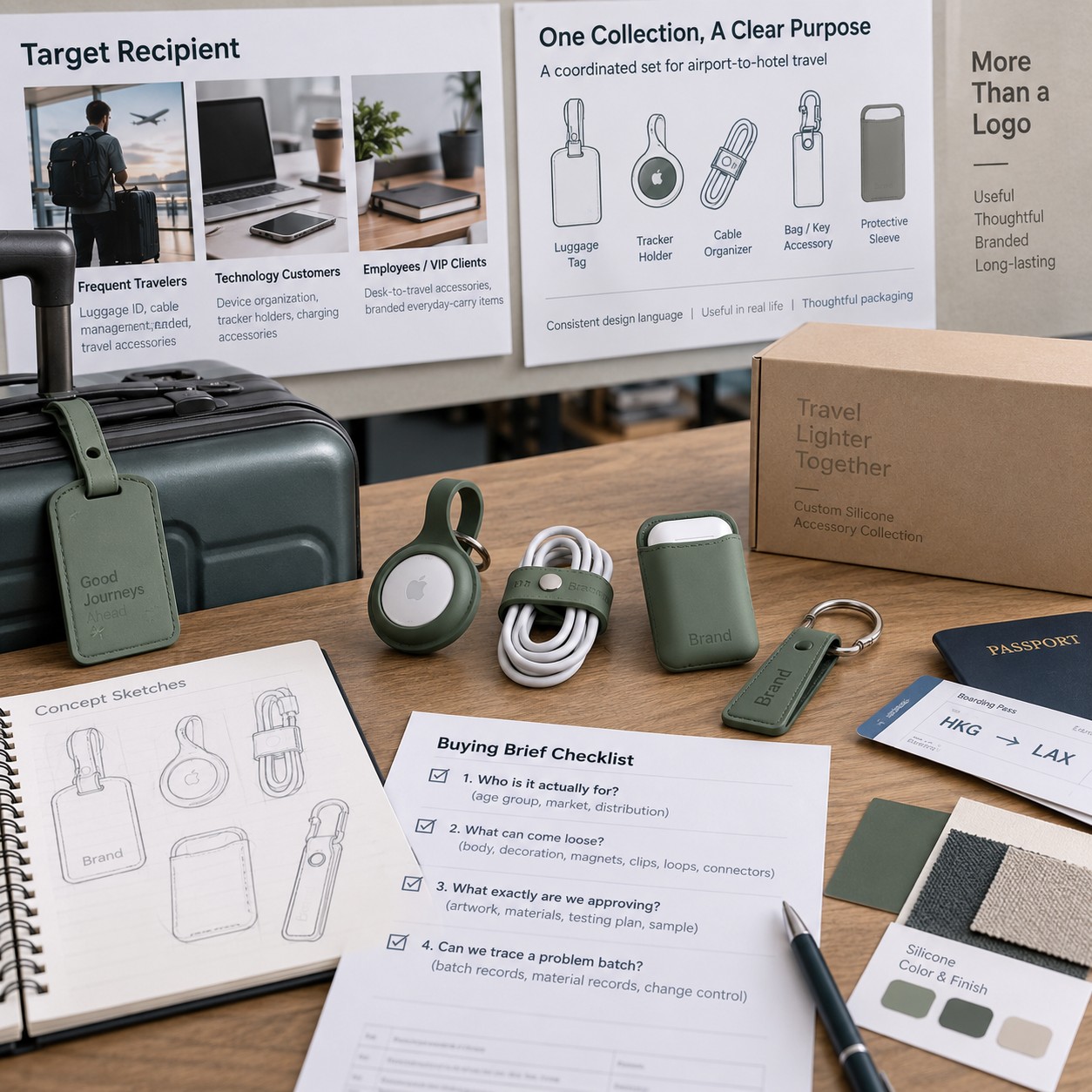
From Retail Product to Premium Branded Gift: Designing a Custom Silicone Accessory Collection
Premium corporate gifting borrows ideas from retail. A useful travel accessory, tracker holder, cable organizer or everyday-carry item can create more perceived value than a conventional promotional product, simply because it feels like something the recipient might have chosen for themselves.
Finding an attractive retail reference is the easy part. The harder questions come next:
- Can it be developed without copying someone else's product?
- Can the concept be adapted to our brand and target audience?
- Can three or five products share the same design language?
- What needs custom tooling?
- How will silicone work with metal, textile, plastic or electronics?
- What testing or compliance requirements apply?
- Can the supplier assemble, inspect and pack the complete kit?
- Can we reorder individual items later without rebuilding the whole program?
These questions turn a promotional-product purchase into a product-development project. For merchandise agencies, corporate-gifting teams and consumer brands, that distinction matters.
Why Premium Gifting Is More Than a Higher Price Point
"Premium" does not simply mean spending more per unit. A premium gift needs to justify its place in the recipient's daily life, usually through a combination of useful function, considered materials, original design, consistent branding, good tactile experience, durable construction and thoughtful packaging. Putting a logo on an expensive generic product does not automatically achieve this.
The more useful question: would the recipient still want to use this product if the logo were smaller? If the answer is no, the program may rely too heavily on branding and not enough on product value. For a custom project, procurement should therefore evaluate unit cost and recipient value separately. They are not the same thing.
Start With the Recipient and the Use Moment
Before requesting product ideas from suppliers, define who receives the gift and when they are likely to use it.
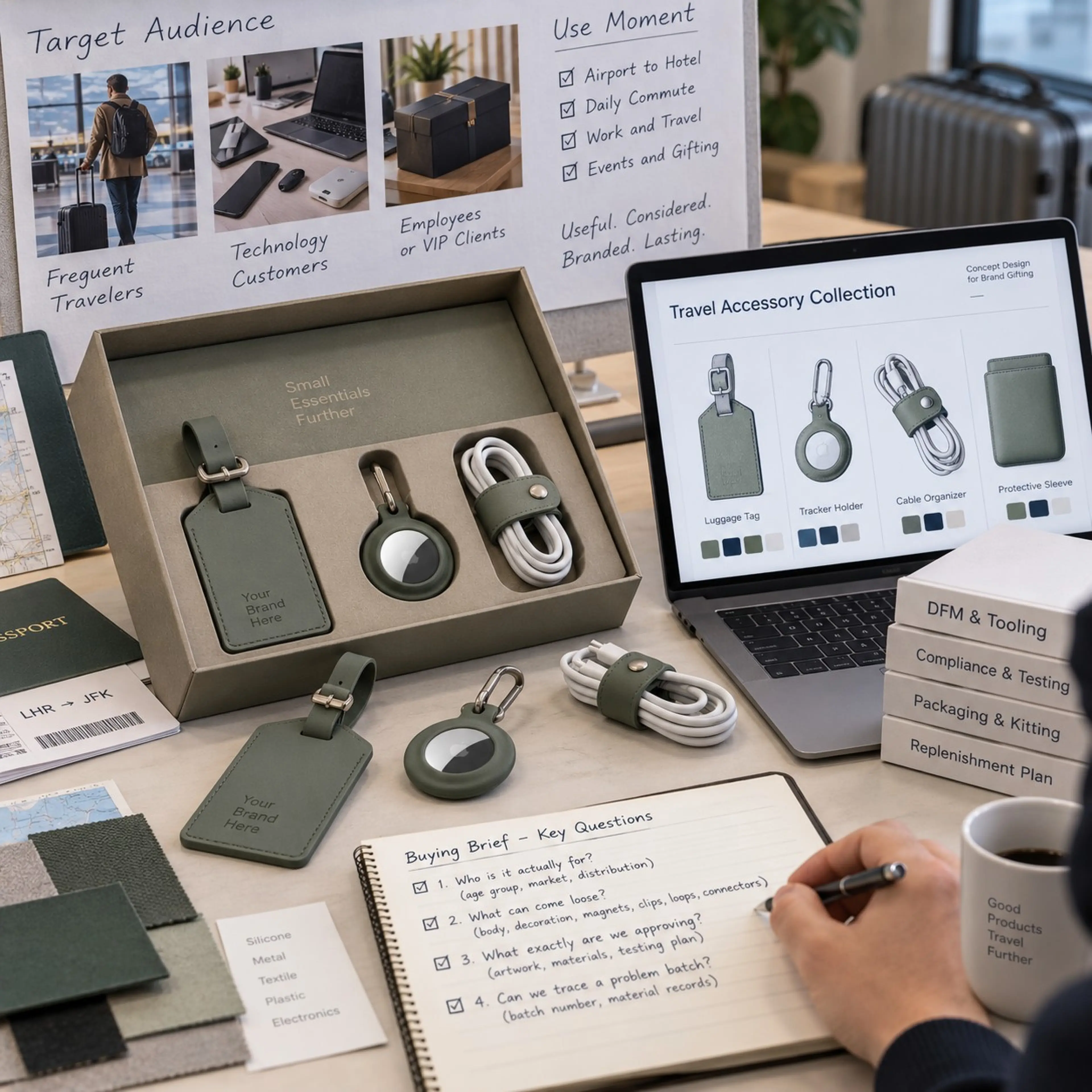
Frequent travelers may need luggage identification, device organization, charging accessories, cable management, bag attachments or compact drinkware accessories. Technology customers may respond to tracker holders, cable accessories, device stands, protective components or charging-related organizers. Employees or VIP clients may shift the emphasis toward desk-to-travel accessories, coordinated everyday-carry items, useful branded objects and premium presentation.
The objective is not to choose as many products as possible. It is to identify a use moment and build around it. A collection designed around "airport-to-hotel travel," for example, is much easier to coordinate than five unrelated items selected because they happen to fit the budget.
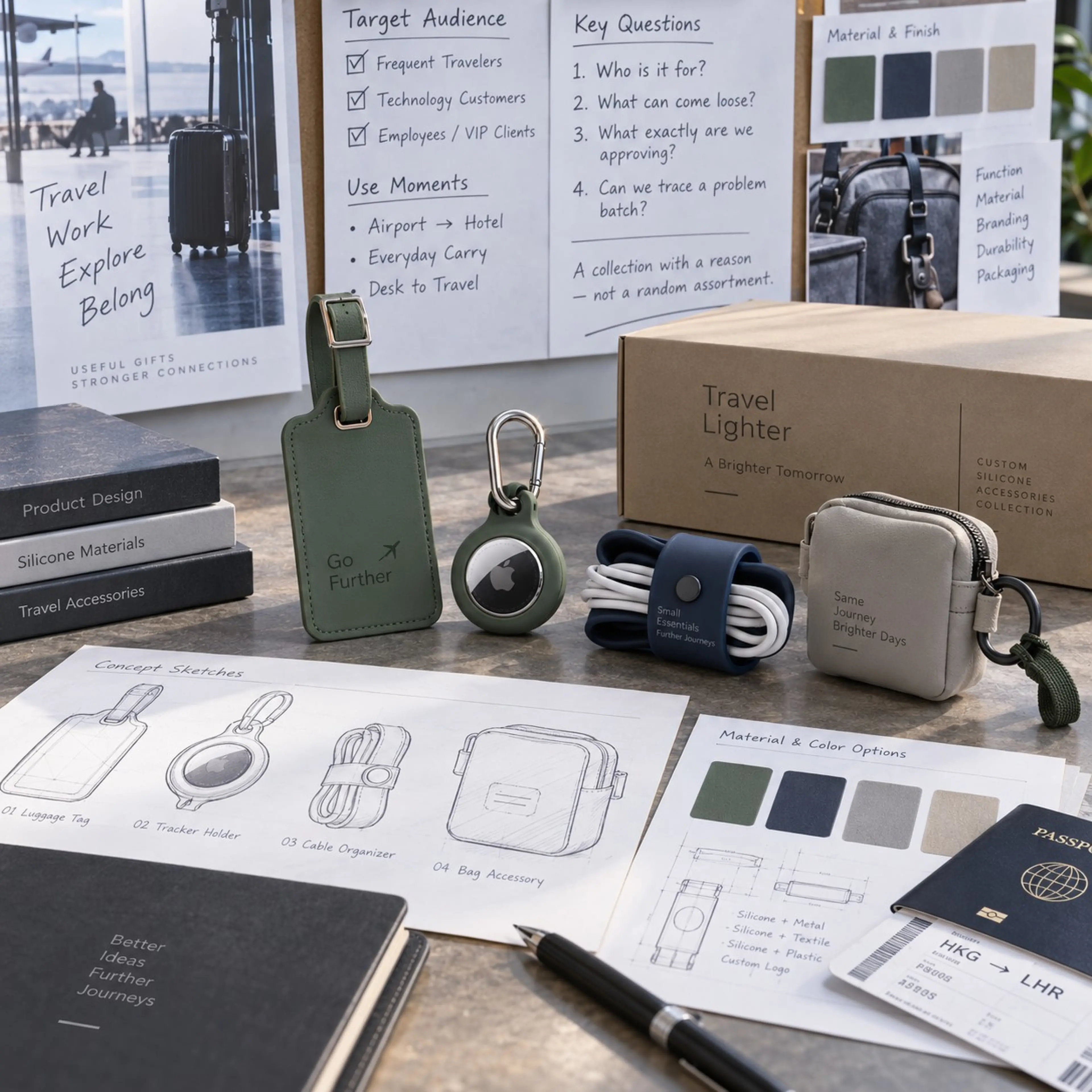
Choose a Product Family, Not a Random Assortment
Combining unrelated products is one of the easiest ways to make a gift set feel promotional rather than retail-ready. A stronger collection has a reason for existing together. For example, a travel-oriented collection could include:
01 — Custom luggage tag. Silicone body or protective element combined with appropriate attachment hardware. 02 — Tracker holder. A molded holder designed around the specified tracking device and attachment method. 03 — Cable organizer. A compact silicone component designed around commonly carried cables. 04 — Bag or key accessory. A branded molded component combined with metal or textile hardware. 05 — Travel tech accessory. A multi-material item where silicone provides grip, protection, sealing or another functional benefit.
These are product-platform examples, not a fixed catalogue. The actual collection should be developed around the campaign brief. Custom development gives the buyer control over function, dimensions, color, branding, materials and packaging, rather than choosing an existing product and adding a logo.
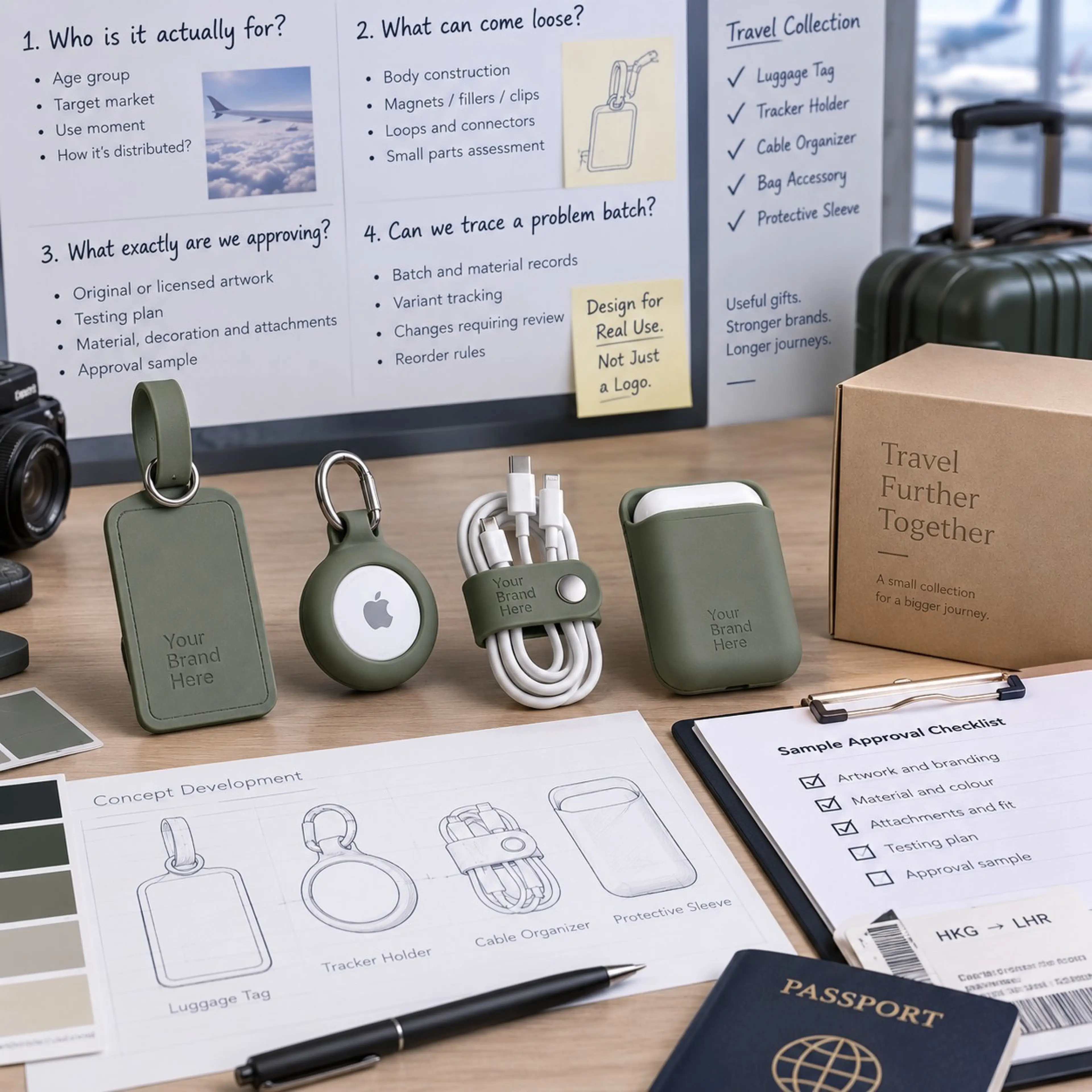
Use Silicone Where It Adds Functional Value
Silicone should not be added to every item simply to make the collection "silicone-based" — that usually produces forced product design. Ask what the material contributes. Silicone is useful when the product needs flexibility, grip, impact protection, a soft-touch interface, a washable surface, molded three-dimensional branding, an elastic retention feature, or integration with a rigid component.
A tracker holder may use silicone because flexibility helps retain the device. A travel accessory may use silicone around a rigid structure for grip or protection. A branded character may use molded silicone because three-dimensional form is central to the visual identity. A component that needs high structural stiffness may be better made from plastic or metal.
The goal is not to maximize silicone content. It is to put the right material in the right part of the product, which generally produces a more credible premium result.
Silicone With Metal, Textile, Plastic, Glass and Electronics
Once a gift moves beyond a simple molded item, procurement becomes more complex. A single accessory might combine silicone with metal (clips, rings, buckles or structural hardware), textile (straps, lanyards or carrying systems), plastic (housings, inserts or structural components), glass (selected drinkware or lifestyle products) or electronics (tech accessories where the soft component performs a defined role).
The buyer should therefore avoid evaluating only the silicone component. The RFQ needs to consider the complete product: mating tolerances, assembly method, component sourcing, material compatibility, surface finishes, hardware specifications, inspection requirements and final packaging.
This is where a simple molded component becomes a finished product costing several times the bare part price — not because silicone became expensive, but because the buyer is purchasing an assembled product system rather than one molded part.
Design Color, Texture and Branding as One System
A premium collection should look like one brand developed it, which becomes challenging across different materials. The same nominal color can appear different on silicone, ABS or PC, coated metal, woven textile and paper packaging. Surface texture changes perception too: matte silicone next to polished metal creates a different visual language from glossy silicone next to bright plastic.
For a collection, establish a simple visual specification covering:
- Color — which Pantone or physical reference controls each material;
- Surface — matte, polished, textured or soft-touch;
- Branding — molded, debossed, embossed, printed, engraved or applied separately;
- Hardware — which metal finish repeats across the range;
- Packaging — whether packaging follows the same color and material system.
Do not wait until production samples arrive to decide whether the collection visually matches.
Build the Interface Map Before Tooling
This matters most for multi-material products. Before opening molds, identify how every component connects — silicone to plastic, silicone to metal ring, silicone to textile strap, plastic to electronic module, finished product to packaging insert.
For each interface, ask what retains the components, what force the connection experiences, what tolerances affect assembly, whether it can be assembled repeatedly, whether it can be replaced, whether it creates a tear or failure point, and whether it requires adhesive, overmolding or mechanical capture.
This is not unnecessary engineering for a gift product. It is how buyers avoid discovering after tooling that a strap pulls out, an insert rotates, a tracker does not fit consistently, or an assembled item cannot be packed efficiently.
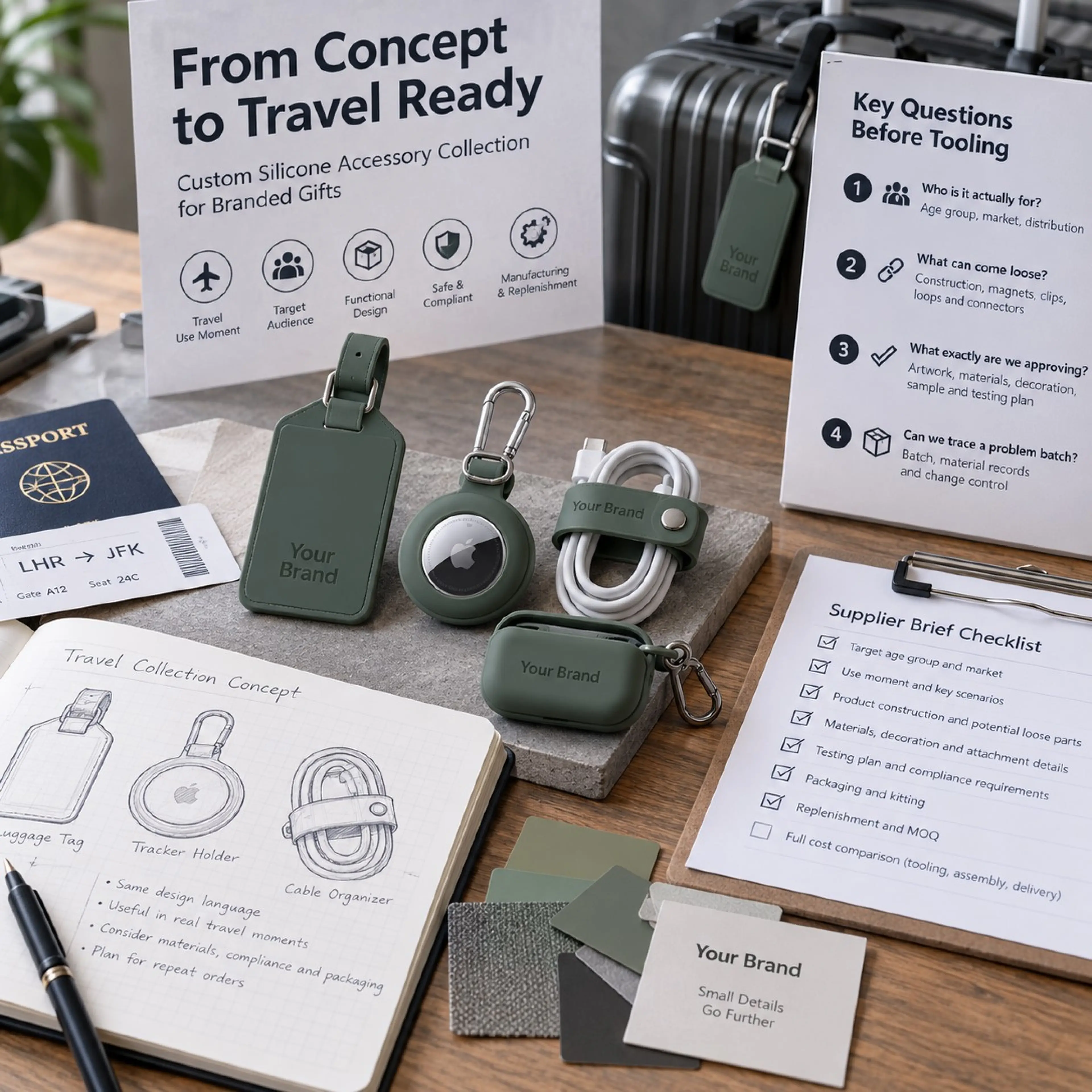
Samples, DFM and Production-Intent Materials
A beautiful rendering is not a production sample. For custom merchandise, distinguish the development stages:
- Appearance prototype — for size, proportion, branding, color direction and overall concept.
- Functional prototype — for fit, interfaces, movement, attachment and basic usability.
- Tooling sample — for the actual molded geometry and manufacturing process.
- Production-intent sample — for the intended combination of materials, colors, hardware, assembly, branding and packaging.
This distinction matters especially for a collection. Approving each component separately does not mean the complete kit has been approved. Before mass production, review the assembled and packaged system, not just loose samples.
Packaging, Kitting and the Unboxing Sequence
For premium gifting, packaging is part of the product — not necessarily elaborate, but intentional. Consider what the recipient sees first, which item is the hero product, whether accessories are visible immediately or discovered sequentially, whether the recipient can understand what each component does, whether the package needs instructions, and whether individual components can be replaced without replacing the whole gift box.
Packaging also has operational consequences. A five-piece gift kit may require incoming component inspection, SKU identification, assembly, inserts, instruction cards, barcode labels, final inspection, kitting and carton planning. If these requirements are known before production, they can be designed into the workflow; if they appear one week before shipment, they become an expensive packing problem.
Safety and Compliance: Adult Gifts Are Not Automatically Toys
A colorful silicone character or collectible may look playful without legally being a toy. Calling something a "corporate gift" does not remove product-specific compliance obligations. The applicable requirements depend on intended user, foreseeable use, product category, materials, electronics, food contact, small components and target market.
Define the intended product classification and target market early. Do not ask the supplier simply whether the product is compliant. Ask which requirements apply to this product, for this intended user, in this target market, and what evidence will be required. That produces a more useful compliance discussion and prevents unnecessary testing against standards that do not apply.
Plan Replenishment, Replacement Parts and Series Extensions
This is one of the biggest differences between a one-off giveaway and a real product platform. A collection may contain a luggage tag, tracker holder, cable organizer, bag accessory and gift box. Six months later, the buyer may need another 2,000 tracker holders but only 500 complete gift sets. Can the supply chain support that?
Before approving the project, consider MOQ by component, shared components, replacement hardware, color continuity, mold ownership, packaging inventory, component lead times and reorder quantities. The same thinking applies to extensions: if the first collection performs well, could the same visual system support a second series rather than starting from zero? A well-designed product family becomes a reusable branded merchandise platform.
What Buyers Should Include in a Premium Gift RFQ
A useful RFQ gives the supplier enough information to evaluate the whole project, not just quote an individual product:
- Target recipient — who receives the gift.
- Use moment — travel, event, employee gifting, product launch, VIP gifting, loyalty program or another scenario.
- Product references — reference products, sketches, mood boards or desired functions. References communicate direction, not a request for unauthorized copying.
- Product family — which three to five products are under consideration.
- Customization scope — new tooling, custom dimensions, custom colors, molded branding, original artwork, custom hardware, multi-material construction.
- Quantity — pilot quantity, first production quantity, expected repeat quantity if known.
- Target budget — a realistic range, which helps decide between full custom tooling, partial customization and an existing product platform.
- Packaging — individual packaging, gift box, multi-product kit, inserts, instructions, labels.
- Target market — US, UK, EU, Canada, Australia or other markets.
- Required delivery date — for event-driven gifting, work backward from the actual in-hand date rather than only a factory completion date.
A Better Question Than "What Gifts Can You Supply?"
For premium gifting, the supplier conversation should not begin with "send me your catalogue." A more useful brief is:
"We are developing a premium travel gift for technology clients. The recipient frequently travels with a phone, tracker and charging accessories. We want three coordinated products using silicone and metal, packed as one gift set, with approximately 2,000 sets required for the first program."
That defines recipient, use moment, product direction, material direction, quantity and delivery format — enough for a development partner to evaluate architecture, materials, tooling and cost realistically.
From a Gift Item to a Branded Product Collection
The strongest premium gifts borrow the discipline of retail product development: designed around a real use case, consistent material and visual language, components engineered to work together, and packaging, assembly and replenishment considered before mass production.
For procurement teams, this means moving beyond product selection → logo → order, toward brief → product architecture → DFM → prototype → validation → tooling → production → QC → kitting → replenishment. That is where custom silicone manufacturing becomes more valuable: silicone is not the gift strategy itself, but one material within a product-development system that may also involve plastic, metal, textile, packaging and assembly.