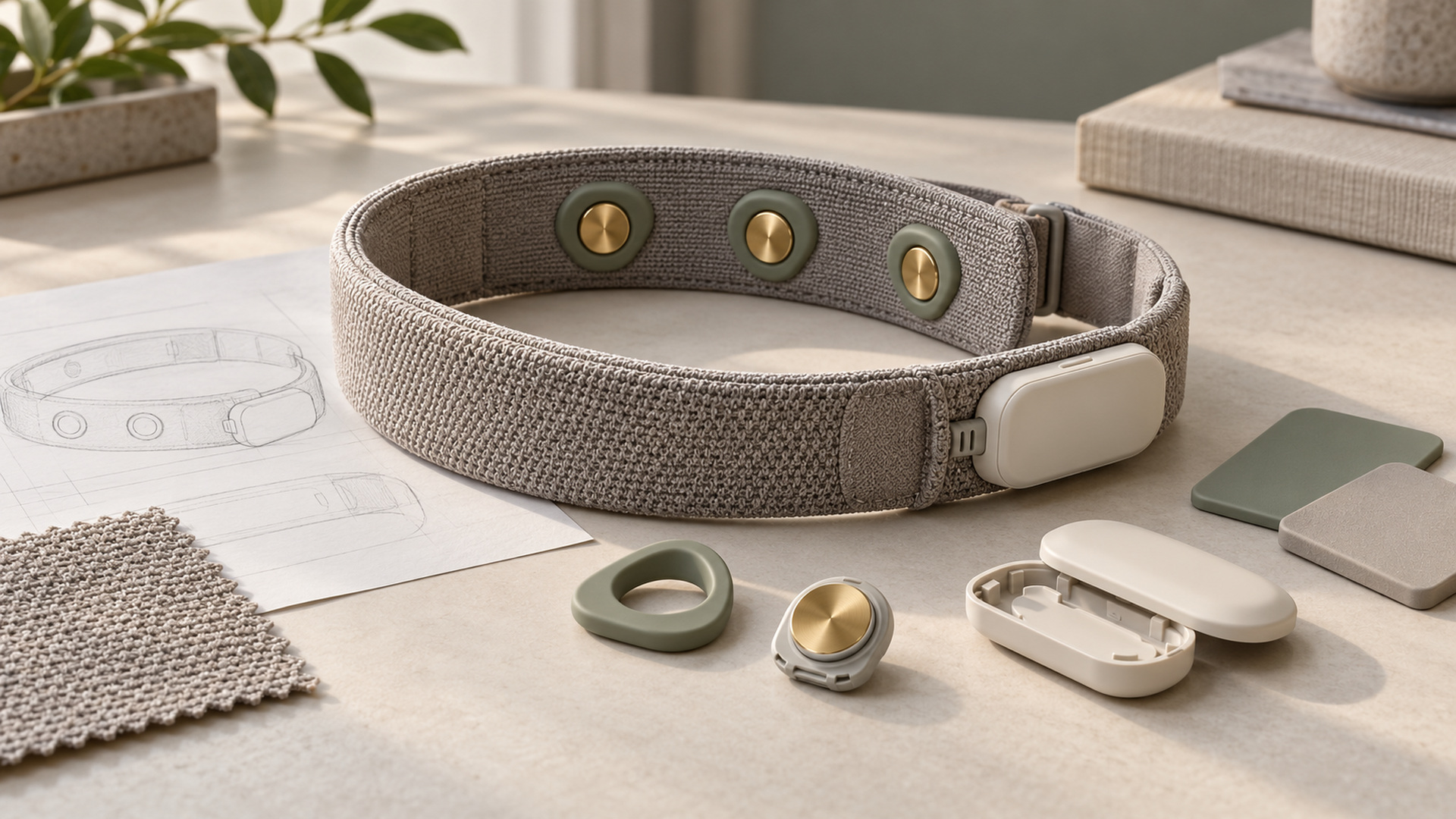
Designing Silicone and Soft-Goods Interfaces for EEG Sleep Wearables
An EEG sleep wearable is not a single-material product. It is a contact system that may combine electrodes, textile, molded soft parts, rigid electronics, battery modules, speakers, sensors, adhesives, fasteners and replaceable consumables. The difficult part is not choosing "a comfortable silicone." It is defining what each layer has to do, then making those layers work together over hours of skin contact, movement, sweat, cleaning and repeated use.
That distinction matters because silicone is useful in some parts of a sleep wearable, but it is not automatically the correct material for every electrode, contact pad or soft interface.
A practical development model is to break the product into four functional zones:
signal-contact zone + comfort/pressure-management zone + structural retention zone + electronics keep-out zone
Once those zones are separated, DFM becomes much more concrete.
Start With Contact Duration and the Intended User
Before selecting materials or molding methods, define how the product is actually worn.
A headband used for a 15-minute pre-sleep session has a different interface requirement from one designed for full-night monitoring. Somnee, for example, describes its current headband as supporting short pre-sleep sessions with optional overnight use, while LumiMind's LumiSleep is designed for overnight EEG monitoring and states up to 12 hours of operation. These are product-specific claims from the brands, not universal design targets.
For an engineering brief, clarify:
- expected contact duration;
- whether the user sleeps in the device;
- head-size range;
- likely side-sleeping positions;
- target electrode locations;
- whether the device must stay stable while the user turns;
- whether the band is adjusted once or every night;
- cleaning frequency;
- whether any part is disposable or replaceable;
- whether the product is a wellness device or falls into a regulated medical-device pathway.
The last point matters: skin-contact, electrical safety and biocompatibility expectations change with product classification and market. Do not assume a consumer wellness wearable and a regulated medical EEG device share the same compliance route.
Dry Electrodes, Hydrogel Pads and Silicone: Different Roles
These materials should not be treated as interchangeable.
Dry electrodes
Dry EEG electrodes establish electrical contact without conductive gel applied each use. iBand+ specifies gold-plated dry EEG electrodes in its product documentation; LumiMind describes multiple soft dry electrodes in the LumiSleep headband. These show that consumer EEG products may use dry-contact systems, but they do not define one universal electrode construction.
For product development, the electrode design has to account for contact area, contact pressure, surface geometry, electrode material and coating, motion relative to the skin, cable or flex connection, and durability after repeated cleaning and flexing. The molded soft-goods structure around the electrode should support stable contact without electrically isolating the contact surface.
Hydrogel or disposable contact pads
Hydrogel pads serve a different function: a conductive and conformable skin interface, usually treated as a consumable system rather than a structural silicone part. If a product uses hydrogel, do not describe it as "soft silicone." The two materials have different electrical, adhesion, aging, packaging and replacement behavior.
The RFQ should state clearly whether the contact element is a dry electrode, hydrogel electrode, adhesive electrode, fabric electrode, conductive elastomer, or another defined system.
Molded silicone
Silicone is valuable around the electrode system for local cushioning, pressure distribution, anti-slip features, cable strain relief, edge protection, flexible housings, retention features and cleanable skin-contact surfaces. But silicone is not automatically the signal-contact material. The design should make clear where silicone is functional, where it is structural, and where it must stay away from the electrical contact path.
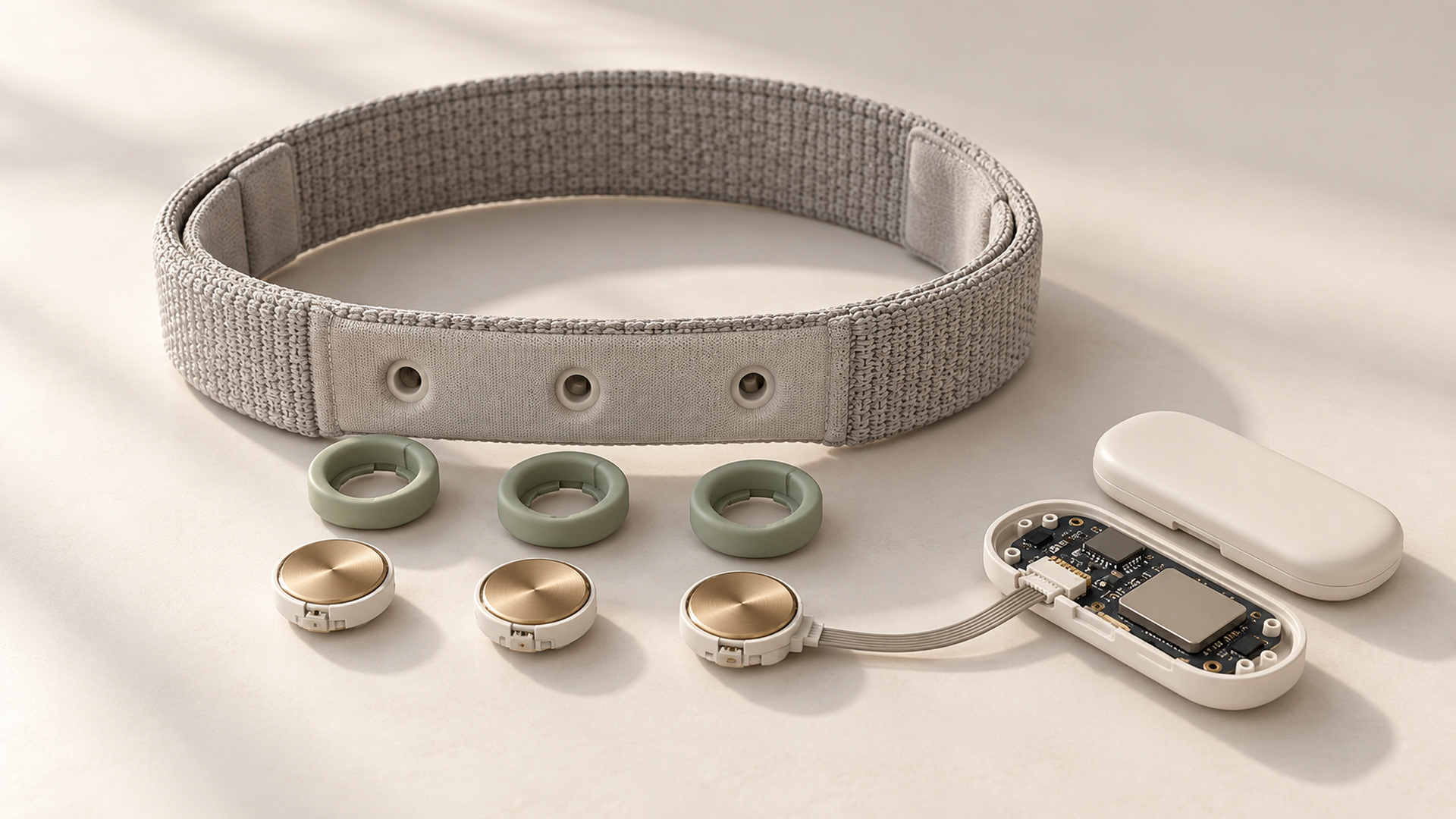
Build a Reusable–Consumable–Washable–Electronic Boundary Map
Before detailed CAD, create a boundary map.
Reusable molded components
Silicone pressure-distribution pads, soft overmolded housings, local anti-slip features, button membranes, strain-relief boots and removable soft frames. These parts should be designed for repeated cleaning and assembly.
Washable soft goods
The textile layer may include headband fabric, elastic sections, hook-and-loop elements, breathable liners and pockets for electronics. iBand+ specifies a detachable, washable strap with anti-slip silicone grip — a clean example of separating the washable band from the sensing hardware.
Consumables
Adhesive electrodes, hydrogel pads, hygiene liners and replacement contact covers, depending on the product. Consumables need their own packaging, shelf-life and replacement logic.
Electronics
PCB, battery, IMU, PPG sensor, speakers, charging contacts, buttons and connectors. The electronics zone should not be forced to follow the same flex, wash and compression behavior as the textile zone.
This boundary map often surfaces the most important architecture decision: what must be removable before washing?
Pressure Distribution Across Head Sizes and Sleep Positions
A headband that feels comfortable on one user can become painful or unstable on another. Pressure depends on more than material hardness: strap tension, local contact width, curvature, electrode protrusion, silicone wall thickness, foam or textile compression, head circumference, skull geometry and side-sleeping load from the pillow.
A softer material is not automatically more comfortable. If the contact area is too small, a very soft pad still creates a high local pressure point. If the structure is too compliant, the electrode moves during sleep and degrades signal stability. The DFM discussion therefore has to consider hardness + contact width + geometry + preload + use position, not hardness alone.
Electrode Retention, Impedance and Motion Artifacts
For an EEG wearable, the mechanical system and the signal system are connected. If the electrode shifts, lifts or rotates relative to the skin, the electrical signal changes. Motion artifacts are influenced by retention force, local sliding, textile stretch, cable movement, user turning, sweat and hair interference.
The public consumer-EEG range of products supports one engineering point: electrode performance depends on the overall wearable architecture, not on the electrode component alone. A supplier evaluating the molded parts therefore needs to know:
- electrode location;
- required movement allowance;
- nominal contact pressure or design target;
- permitted rotation;
- how the electrode is retained;
- how wiring exits the contact zone;
- what surfaces must remain exposed.
Without that information, a silicone housing can be dimensionally correct and still interfere with signal performance.
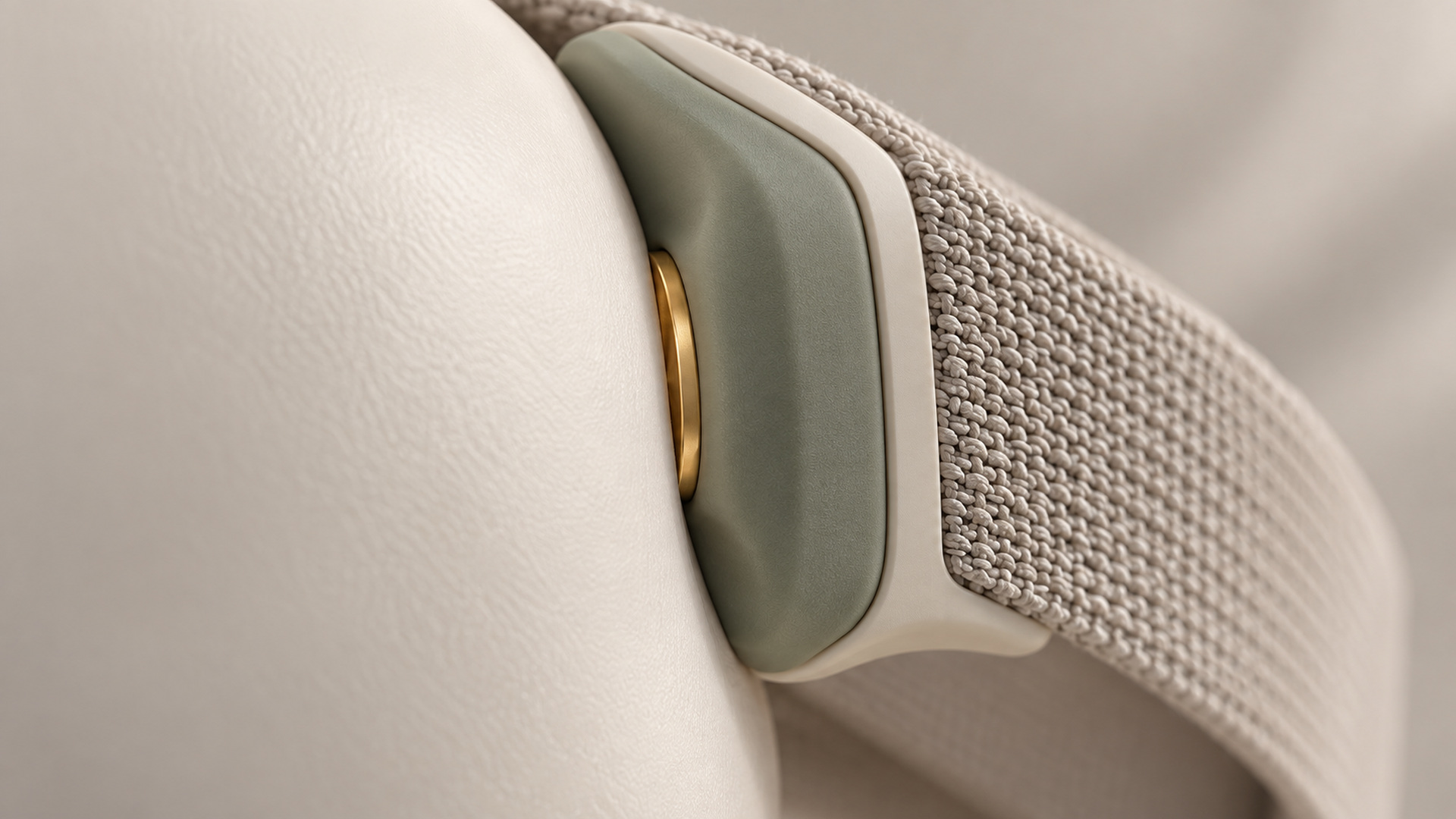
Where Molded Silicone Can—and Cannot—Help
Silicone is useful where the design needs controlled softness and repeatable geometry.
Good candidates: edge cushioning, local pressure pads, anti-slip ribs, soft electrode carriers that do not cover the contact surface, sensor housings, flexible cable exits, button membranes, removable washable components and hard-soft transition zones.
Areas requiring caution: high air permeability, direct conductive electrode contact, moisture absorption, geometries that trap sweat, soft molded walls over sensor windows, and bands that need broad textile stretch rather than local elastomeric deformation.
The material decision belongs at interface level, not product level. A sleep wearable may be "soft," but its best architecture can still use textile for large-area comfort, molded silicone for localized control, and rigid plastic or metal for electronics and retention.
Hardness, Contact Width, Texture and Local Wall Thickness
Silicone hardness is overused as the main specification. Perceived comfort depends on the complete geometry:
- a 40 Shore A pad with a wide contact area may feel less aggressive than a softer but narrow protrusion;
- thin silicone over a rigid insert feels harder than the same material in a thicker free section;
- raised texture improves grip but can create localized pressure;
- a hollow or ribbed structure adds compliance without changing raw-material hardness.
For development, define nominal hardness range, local wall thickness, contact footprint, edge radius, texture, compression target and rigid backing geometry. Approve the feel with molded parts in the complete assembly, not with loose material plaques alone.
Textile-to-Silicone and Rigid-to-Soft Retention
A sleep headband usually contains several interfaces.
Textile-to-silicone options include mechanical capture, molded-through openings, sewn retention features, pockets, removable inserts and selected bonding processes. The right route depends on washability, replacement and load: if the textile has to be washed separately, permanent bonding creates a serviceability problem.
Rigid-to-soft, silicone can be mechanically captured by plastic, overmolded onto a compatible substrate, assembled using undercuts or grooves, retained with fasteners, or designed as a removable sleeve. Do not default to chemical bonding if the product is meant to be serviced. The key question is often not "how strong can we bond it?" but should this interface be permanent at all?
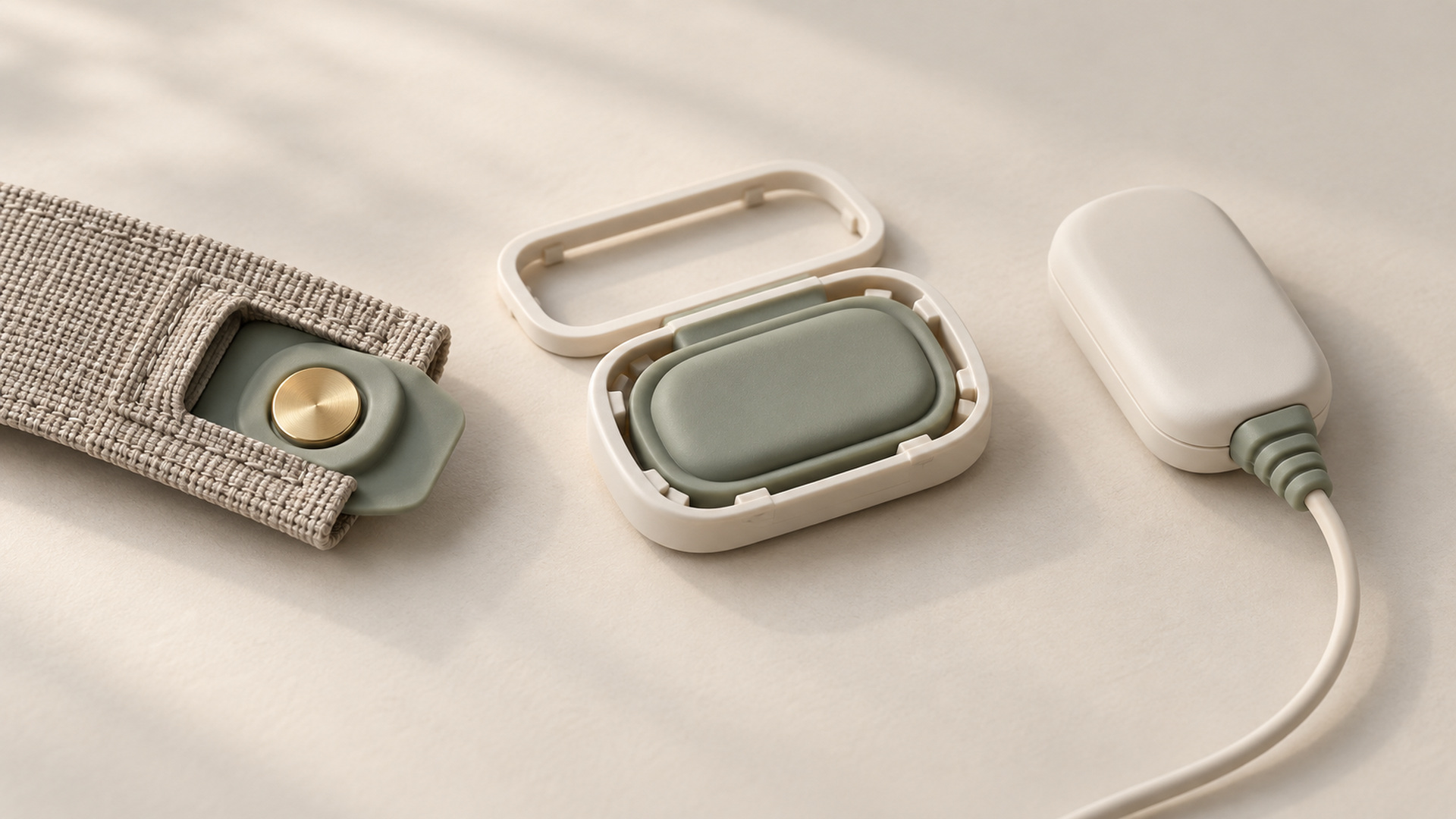
Buttons, Speakers, Sensors, Battery and Thermal Keep-Out Zones
Soft goods should not solve one problem by creating another. Electronics impose keep-out requirements: buttons needing defined travel, microphones or speakers needing acoustic openings, PPG sensors needing a clear optical path, charging contacts that must stay accessible, batteries that should not sit under high compression, rigid PCB edges that should not create pressure points, and heat-generating zones that should not be over-insulated without analysis.
For DFM, give the mechanical supplier a keep-out map showing sensor windows, acoustic openings, charging points, flex zones, no-compression battery zones, button travel and antenna constraints where relevant.
Sweat, Sebum, Cleaning and Overnight Humidity
An overnight wearable sees a different environment from a short-use handheld product. The soft interface may be exposed to sweat, skin oils, hair products, cosmetics, cleaning agents, repeated humidity, pillow friction and long contact duration.
Validation should use the actual cleaning method planned for the product. Questions to resolve: which parts are wiped, washed or replaced; can liquid reach electronics; can detergent residue remain in textile; can oils alter grip or surface feel; can repeated cleaning change the retention fit.
Do not claim compatibility with sweat, sebum or cleaners based on generic silicone properties alone. The actual grade, surface finish, pigments and assembly must be validated.
Replaceable Parts, Hygiene Packs and Serviceability
A wearable architecture should anticipate wear. Service parts may include electrode modules, washable straps, soft contact pads, silicone retainers, hygiene liners and charging accessories. Serviceability reduces the need to replace the entire electronic device when the skin-contact layer wears or becomes hard to clean.
For the manufacturer this implies a different tooling strategy: a durable electronic core, replaceable molded soft parts, a washable textile SKU, a consumable pack and controlled replacement instructions. That simplifies long-term maintenance only if part identification and interchangeability are designed from the start.
Headform, Side-Sleep and Repeated-Use Validation
A flat-bench fit check is not enough. Useful validation may cover multiple head circumferences and representative headforms, side-sleep positions, repeated donning and removal, strap adjustment cycles, electrode insertion and removal, cleaning cycles, overnight humidity exposure, cable flexing, button actuation and visual inspection of pressure-mark zones.
The exact test plan depends on the product. Do not invent a universal cycle count or pressure limit unless the product team has defined one. For consumer products the acceptance criteria may be internally developed; for regulated devices, additional requirements may apply and should be confirmed with compliance specialists.
What to Include in an EEG Wearable RFQ
A useful RFQ lets the supplier understand the system, not only the silicone part. Include:
- product classification and target market;
- intended user and contact duration;
- full-night or short-session use;
- head-size range and electrode location;
- electrode type — dry, hydrogel, adhesive or other;
- CAD and 2D drawings;
- textile construction;
- required hardness range and local wall-thickness targets;
- skin-contact surfaces;
- electronics keep-out zones;
- cleaning method and washable versus non-washable components;
- expected replacement parts;
- assembly method, target quantities, cosmetic and validation requirements.
If the project is still early, a complete production drawing is not required to start a DFM discussion. But the interface map should be clear enough to separate electrode / pressure / textile / molded soft part / rigid housing / electronics / consumable. That is what keeps a soft-goods concept from becoming an ambiguous manufacturing brief.
Design the Interface System, Not Just the Silicone Part
For EEG sleep wearables, comfort, signal quality and manufacturability are connected. The useful development sequence is:
- define the contact duration and user;
- define the electrode system;
- map reusable, washable, consumable and electronic zones;
- define pressure and retention requirements;
- choose where molded silicone adds real value;
- design textile-to-soft and rigid-to-soft interfaces;
- validate the complete assembly across head sizes and sleep positions.
This avoids two common mistakes: treating every soft component as silicone, and treating every electrode interface as a molding problem.
Technical References
The examples below are external references illustrating current EEG/sleep-wearable architectures. They are not ESKY SUPPLY projects, and product-performance claims remain the responsibility of the respective brands.
- LumiMind — LumiSleep Product Page
- LumiMind — Product Usage Help Center
- Somnee — Smart Sleep Headband
- Somnee — Press / Product Updates
- NewDealDesign — Portfolio
- iBand+ — Product Page
- iBand+ — User Manual
These references illustrate existing wearable architectures only. They do not prove that a specific silicone grade, electrode design, contact pressure, cycle life or regulatory pathway suits another product. Those requirements must be validated for the intended device and market.