How should loaded service life be specified for bottle straps and carry handles?
A bottle strap or carry handle almost never fails because the silicone itself is weak. It fails at the junction — where the strap meets the anchor point, the rivet, the D-ring, or the overmolded hook — under a load that was never written down. The practical fix is to stop asking for a "strong" strap and start specifying what weight it carries, in which direction it is pulled, and how many load cycles it must survive before the buyer calls it worn out.
For brand owners moving a custom bottle accessory toward tooling, this matters at exactly the moment the first prototype feels fine. A hand-made sample survives a weekend of real use; that does not tell you whether the 10,000th unit will survive twelve months of loaded carrying, clipping, and swinging from a bag.
Define the load case before the material
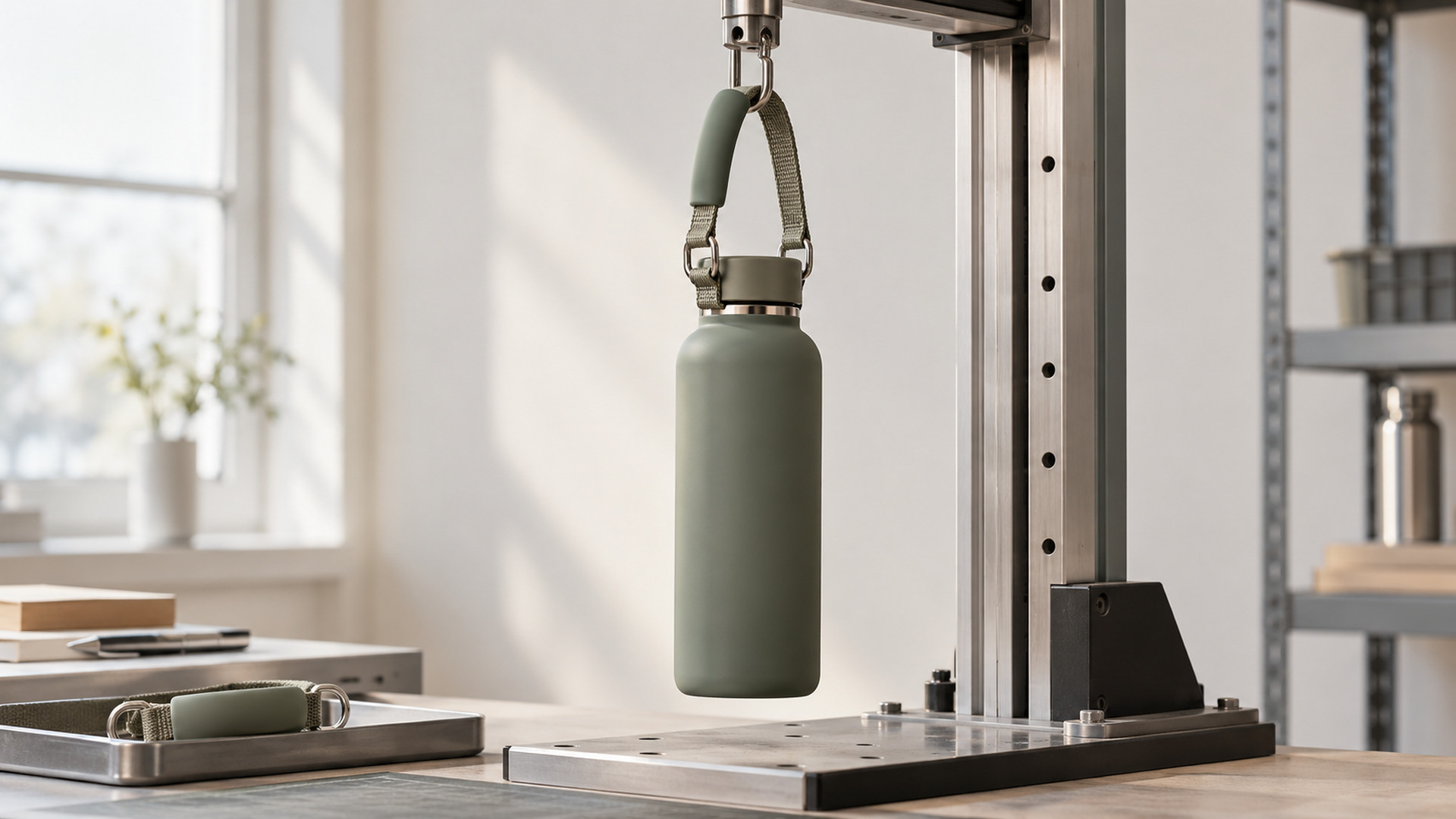
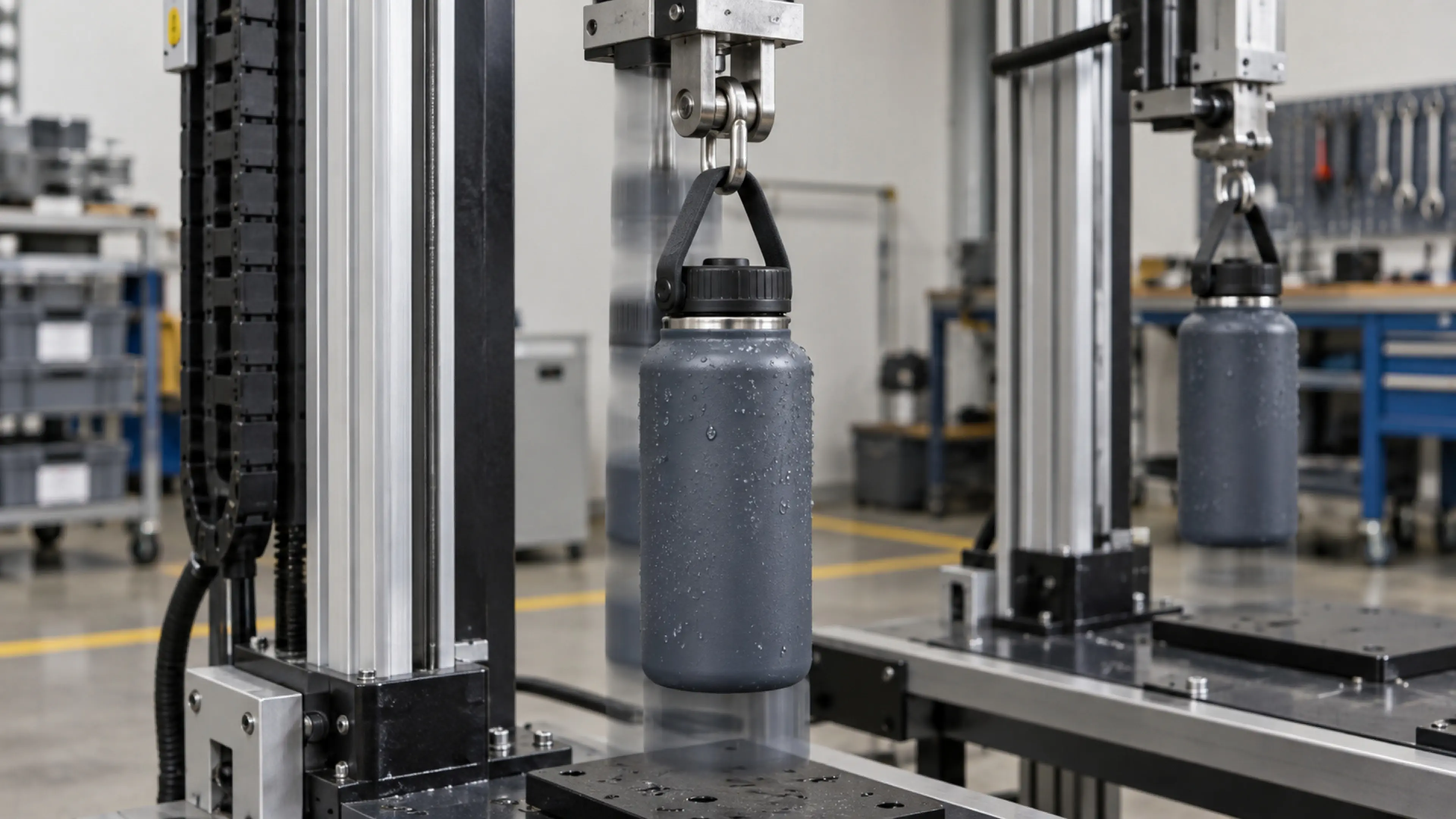
Service life has to be tested against a representative filled weight and the real directions of loading, not against an abstract tensile number on a data sheet. A 75 Shore A strap can feel indestructible in a straight pull yet tear at an earlet when a loaded bottle swings sideways into a table edge.
Write down the load case as part of the brief:
- Filled weight. The actual filled bottle, not the empty shell — water bottles change load dramatically once full and cold.
- Loading directions. Vertical hanging, one-handed carry, sideways swing, snagging on a table or car door, and accidental drops.
- Cycle type. Clipping and unclipping, stretching over the cap, folding, repeated attachment to a bag loop.
- Environment. Dirt, sweat, sunscreen, washer or hand rinsing, and UV exposure over the product's life.
Two quotes built on different assumptions — one tested empty and hanging straight, one tested full and off-axis — will not agree on whether the design is sound.
Where straps actually break
The highest stress rarely sits in the middle of the strap. It concentrates at the transitions:
- The overmolded anchor where silicone wraps a metal or plastic insert.
- The eyelet, hole, or loop that the carabiner passes through.
- The thin-to-thick transition near a grip area.
- Any sharp internal corner that acts as a starter crack.
Inspect these zones first on the first samples. A strap that tears at the eyelet after a few hundred pulls is not a material-grade problem; it is a geometry problem that usually needs a wider radius, a reinforced eyelet, or a mechanical capture around the hardware rather than relying on silicone alone to retain it.

Turn loaded life into an acceptance test
"Durable" does not survive production approval. Convert the requirement into a short written spec that the factory, the buyer, and the inspector all read the same way:
- A controlled reference. An approved sample (ideally the pilot-production piece, not the handmade prototype) that everyone agrees represents the acceptable feel and pull.
- Critical characteristics. The anchor pull-out force, the eyelet tear resistance, and the loaded-cycle count before any cracking or hardware detachment appears.
- A test condition. Loaded weight, pull direction, cycle rate, and whether the strap is tested on its own or assembled into the finished bottle/carrier.
- An acceptance rule. What passes and what fails — e.g., no visible tear after the defined cycle count, hardware not pulled out above the agreed force.
- A revision record. Which drawing, sample, and packaging version the approval refers to, so a later reorder is judged against the same baseline.
Prototype success is evidence the concept works, not proof that production variation is solved. Hand-cut or 3D-printed prototypes use a different process than compression- or injection-molded production parts, so prototype results should be re-confirmed on pilot tooling.
Comparing routes without chasing a headline number
If an overmolded metal insert looks expensive against a stitched textile loop, compare the two on the same criteria: assembly steps, repeatability, what the attachment survives, and how it is inspected. A cheaper join that later requires rework or generates returns on a loaded product is rarely cheaper once field failure is counted.
The same caution applies to supplier comparisons. A price that covers only the molded strap is not comparable to one that includes hardware insertion, pull testing, and a defined inspection plan. Ask each supplier to list what is excluded before choosing on unit price.
What to agree before tooling
Before a supplier commits to tooling, the brief should state: the filled weight and use directions above, the acceptable failure modes (tear, anchor pull-out, hardware loss), mating-part dimensions for the bottle and any carabiner or clip, the target market, and the expected repeat-order volume. If the product will be sold in Europe, confirm up front whether it actually falls under legislation that requires CE marking — do not add a mark by default just because the destination is European.
Useful supplier questions:
- How will the eyelet and anchor be pull-tested, and on assembled units rather than loose straps?
- What cycle count do you design to, and how is that confirmed on pilot parts?
- Which failure mode are you designing the geometry against first?
- What is included in the quote — molding, hardware insertion, pull testing, inspection, and packaging?
Conclusion
Specifying loaded service life is not about naming a stronger silicone. It is about writing down the filled weight, the loading directions, and the cycle count that matter to the real user, then putting those on the drawing and into the sample approval. Done that way, a strap design can be tested before steel is cut, and repeat orders can be judged against a number instead of a feeling.