How should requirements differ for bottle mouthpieces, seals and protective sleeves?
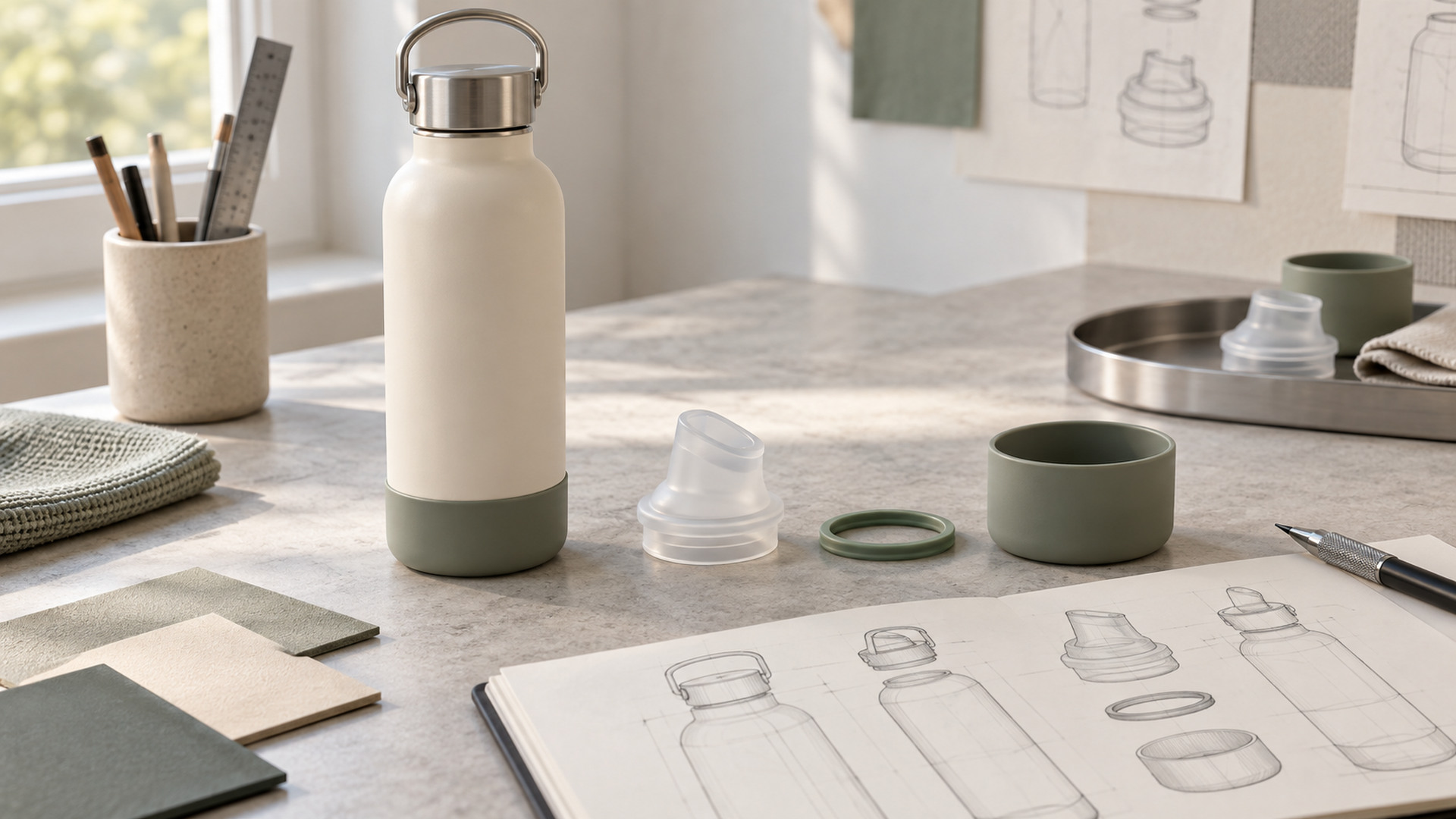
A water bottle or food jar rarely needs one silicone part — it needs three, and they have three different jobs. The mouthpiece goes in the mouth and sees hot or acidic drinks. The sealing gasket keeps liquid in and is compressed thousands of times. The protective sleeve grips the outside of the bottle and sees hands, bags, drops and dishwasher cycles. Treating them all as "food-grade silicone" is a starting point, not a spec.
For product teams designing bottle accessories, travel cups or food storage, the design requirement should be differentiated by what each part does and what it contacts — not by a single material grade applied across the whole accessory.
Why one spec does not fit all
Lifestyle and outdoor accessories usually fail at the interface between soft material, repeated handling and mixed-material hardware. Cleaning, loading, one-handed use, dirt, moisture and storage matter as much as the nominal silicone grade.
The three parts of a bottle accessory see very different worlds:
| Part | What it contacts | Main failure mode |
|---|---|---|
| Mouthpiece | Mouth, hot/cold drinks, flavors | Bite wear, taste, staining |
| Sealing gasket | Liquid, compression, screw threads | Compression set, leakage |
| Protective sleeve | Hands, bag friction, drops, dishwasher | Tears, slip, discoloration |
Mouthpieces: comfort and cleanability
The mouthpiece is the part users actually taste and bite. Requirements lean toward:
- A soft but not chew-torn surface.
- A shape that drains and does not trap liquid.
- A finish that does not retain flavors or colors.
- Material rated for food contact.
It is not the place for the firmest, highest-wear compound — it is the place where bite comfort and cleanability dominate.
Sealing gaskets: compression set and fit
The gasket's job is to recover its shape after being compressed, cycle after cycle. Requirements lean toward:
- A silicone grade with low compression set.
- A geometry that compresses evenly against the bottle neck.
- A fit that stays put when the lid is opened.
A soft, sticky gasket might feel nice but will set and leak. A firmer, recovery-oriented grade seals better.
Protective sleeves: grip and durability
The sleeve takes the abuse: drops, bag friction, dishwasher cycles, UV. Requirements lean toward:
- A grippy surface finish.
- A wall thick enough to absorb impact but flexible enough to slide on.
- Resistance to discoloration from drinks and washing.
- A fit that stays on but can be removed for cleaning.
Key design variables
Across all three parts, the following drive robustness:
- Actual user action — carrying, biting, squeezing, cleaning, folding, clipping or refilling.
- Load path through silicone, plastic, metal or textile components.
- Areas that trap residue or are hard to dry.
- Part retention and accidental release under real handling.
- How the accessory will be packed, replaced and repeated across a product family.
Turn each part into its own acceptance standard
"Food-safe" is not enough. Convert each part's requirement separately:
- A controlled reference — an approved sample for each part.
- Critical characteristics — mouthpiece bite feel, gasket compression, sleeve grip.
- A test condition — dishwasher cycles, hot drinks, drop tests.
- An acceptance rule — no leakage, no taste transfer, no tear after N cycles.
- A revision record — which material grade and finish each part uses.
Compare options by trade-off
Using one grade across all three parts simplifies purchasing but compromises at least one of them. A dedicated mouthpiece grade, a compression-set gasket grade and a durable sleeve grade costs a little more per part but avoids field failures.
Validate in the real assembled state
Test the bottle assembled — filled, capped, dropped, washed. Testing an isolated silicone mouthpiece misses problems created by the full bottle, the lid and the dishwasher cycle.
What to prepare before the RFQ
- CAD or samples of the bottle, lid and each silicone part.
- What drinks or foods contact each part, and at what temperature.
- Cleaning method (dishwasher, hand wash, boiling).
- Drop and abuse expectations.
- Food-contact regulatory requirements for the target market.
- Target volume and product family plan.
If one material grade is currently assumed, ask the supplier whether the mouthpiece, gasket and sleeve should each be specified separately.
Questions to ask the supplier
- Do you recommend different grades for the mouthpiece, gasket and sleeve?
- Which gasket grade has the best compression set for this lid design?
- How does the sleeve survive dishwasher cycles and drops?
- How do you test taste retention and cleanability of the mouthpiece?
- Which food-contact documentation covers the finished assembled product?
Generic "food-grade silicone" answers without separating the three parts are not enough.
Conclusion
A bottle accessory is three products in one. The mouthpiece is about bite comfort and cleanability, the gasket is about compression set and sealing, and the sleeve is about grip and abuse resistance. Specify them separately, validate the assembled bottle under real cleaning and drop conditions, and the accessory lasts longer than if it were built from a single generic grade.