Postcure-Free Self-Adhesive LSR: What Buyers Still Need to Validate in Hard–Soft Components
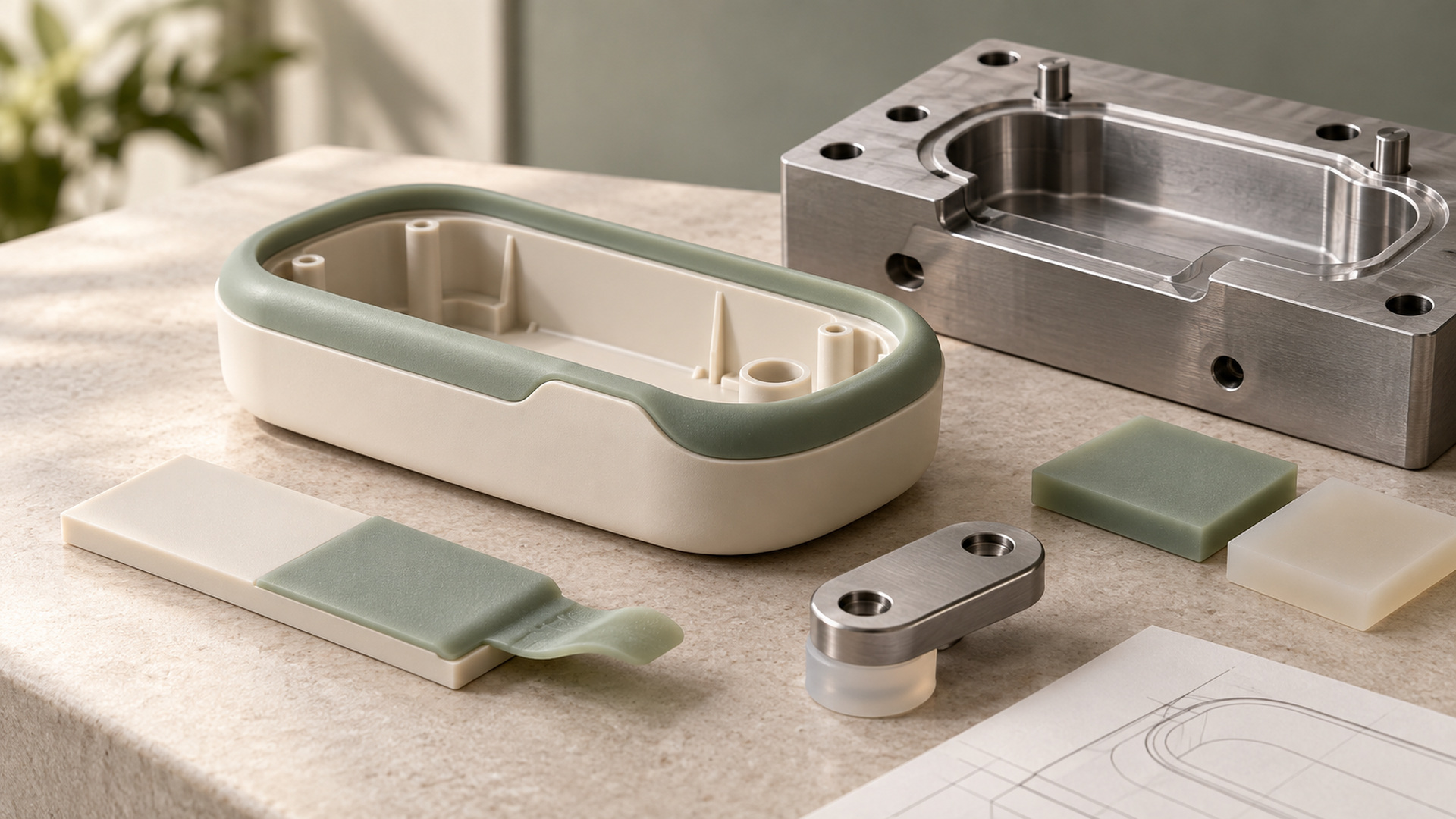
Self-adhesive liquid silicone rubber can remove process steps from some hard–soft component programs. Newer LSR systems may combine primerless adhesion with low volatile content, and specific grades can be processed without a separate thermal postcure for defined applications. That simplifies production flow, reduces handling and shortens the route from molding to inspection or assembly.
But buyers should be careful with the phrase postcure-free. It does not mean:
- every self-adhesive LSR can skip postcuring;
- every PBT, PET or metal grade will bond equally well;
- the bond will survive every cleaning, sterilization or aging condition;
- pigments and additives have no effect;
- food, infant or skin-contact documentation automatically applies to the finished component;
- a successful first-shot sample guarantees repeatable mass production.
The engineering question is not whether self-adhesive LSR can remove postcure. It is whether this exact LSR, substrate, surface condition, molding process and use environment deliver a stable hard–soft interface without a separate postcure step. That is what should be validated before tooling is frozen.
What "Self-Adhesive" and "Postcure-Free" Actually Mean
These two terms describe different things.
Self-adhesive LSR is formulated to develop adhesion to selected substrates during or after molding, without a separately applied primer in the conventional sense. That is not universal adhesion. WACKER technical data for self-adhesive grades repeatedly states that bonding depends on the individual surface properties of the substrate and that each substrate should be tested before mass production. "Self-adhesive" describes a material capability under suitable conditions, not a blanket compatibility statement.
Postcure-free refers to a secondary heat-treatment step used for some silicone applications to further reduce volatiles, stabilize properties or satisfy a specific requirement. A material described as postcure-free is one for which the supplier states that an additional thermal postcure is not required for the intended use under the stated conditions. That claim is grade-specific: WACKER's ELASTOSIL® LR 5471, for example, has been presented as a self-adhesive LSR that does not require a separate thermal postcure and is intended for hard–soft composite parts, including adhesion to selected metals and thermoplastics such as PBT and PET. Other grades may still require postcuring for food-contact use, volatile-content limits, or another application-specific reason.
Start With the Exact LSR and Substrate Grades
"Silicone on PBT" is not a complete material specification. Neither is silicone on PET, silicone on metal, or silicone on plastic. Two PBT compounds can behave differently because of glass-fiber content, flame-retardant package, lubricants, mold-release additives, colorants, recycled content or surface finish. The same applies to PET and engineering metals.
A practical hard–soft RFQ should identify the LSR manufacturer and grade, substrate manufacturer and grade, filler level, color or masterbatch, surface coating, plating, cleaning method, and upstream molding or machining process. If the substrate grade is not yet fixed, say so. The material pair should then be validated before the mold design assumes a permanent chemical bond.
PBT, PET and Metal: Why Surface Condition Still Matters
A chemically compatible material pair can still fail if the surface reaching the LSR mold differs from the one used during development. Possible causes: mold-release residue, machining oil, fingerprints, dust, storage contamination, plating variation, oxidation, surface-treatment drift, moisture, cleaning-agent residue.
Self-adhesive LSR does not remove the need for surface control. For PBT and PET inserts, know whether the insert comes directly from an upstream injection-molding cell or is transported and stored before overmolding. For metal parts, the specification should include the actual surface state, not only the alloy: stainless steel + passivation + defined cleaning is a more useful engineering description than "metal insert." The interface is created on the surface that actually enters the mold.
Chemical Adhesion, Mechanical Lock or Both?
A hard–soft component can rely on chemical adhesion, mechanical retention, or both. Treat them as separate design tools.
Chemical adhesion simplifies geometry and creates a continuous interface — useful where sealing continuity matters, the soft layer is thin, visual surfaces must stay clean, or mechanical locks would create unwanted geometry. But the bond is sensitive to the material pair and process window.
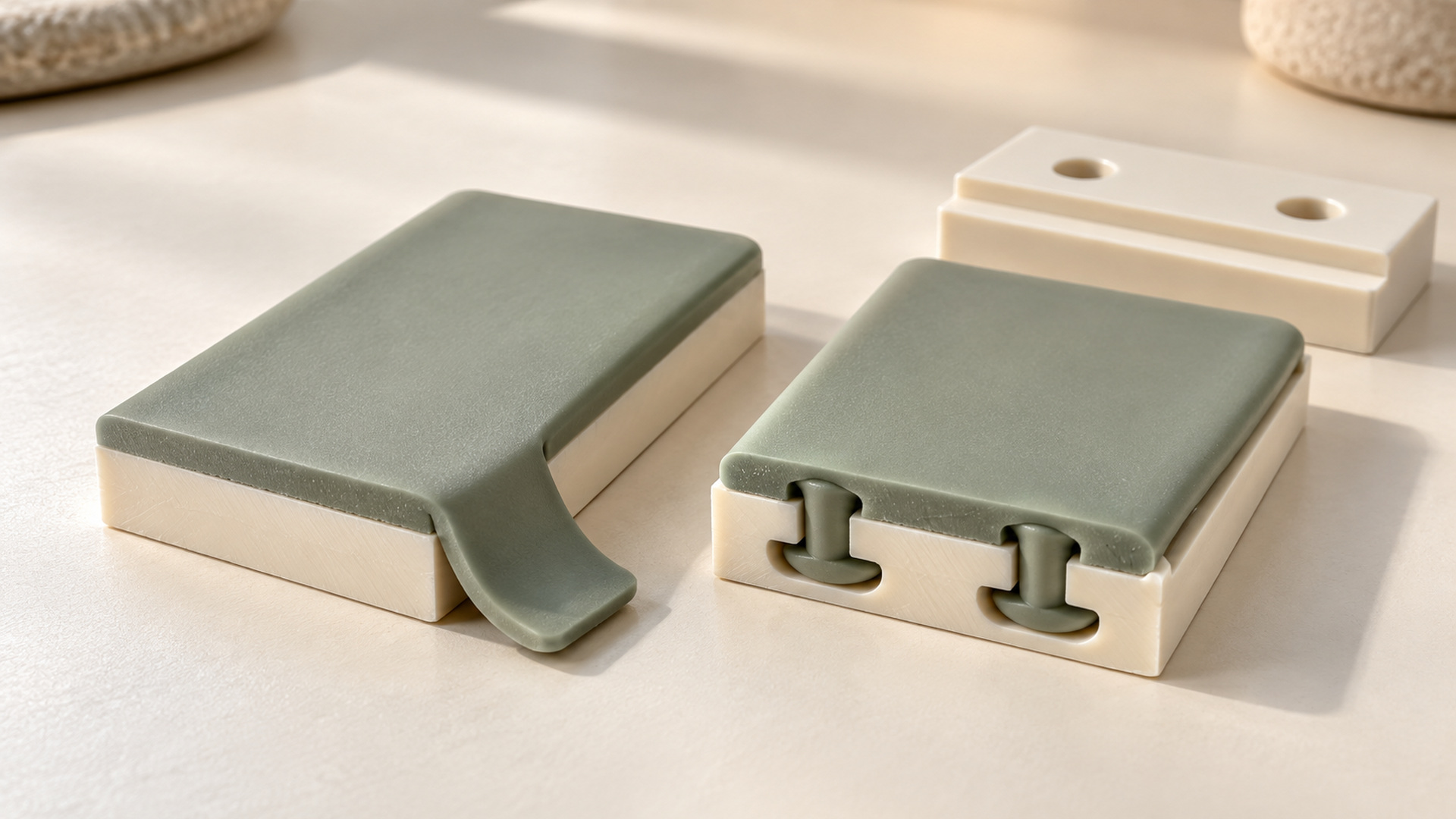
Mechanical retention uses through-holes, grooves, undercuts, ribs, captured edges or perforated inserts. It provides a second retention path even if chemical adhesion changes over time. It is not automatically better: it can create stress concentration, flash-control challenges, difficult demolding, local tearing and cleaning traps.
For higher-risk components, chemical adhesion plus well-designed mechanical retention reduces reliance on a single mechanism. The right choice depends on the failure consequence — a cosmetic grip and a critical seal should not automatically use the same bonding strategy.
Pigments, Additives and Release Agents
Material compatibility should not be validated only with unpigmented laboratory samples. Production formulations may include color masterbatch, friction modifiers, processing aids, fillers, stabilizers and other additives permitted by the material supplier. The rigid substrate may also contain additives that influence adhesion.
Before approval, test the actual intended formulation. If a new pigment, release-agent system or resin formulation is introduced later, it enters change control rather than being treated as a purchasing-only substitution. The approved combination should be recorded by grade and revision.
Insert Temperature, Mold Design and Demolding
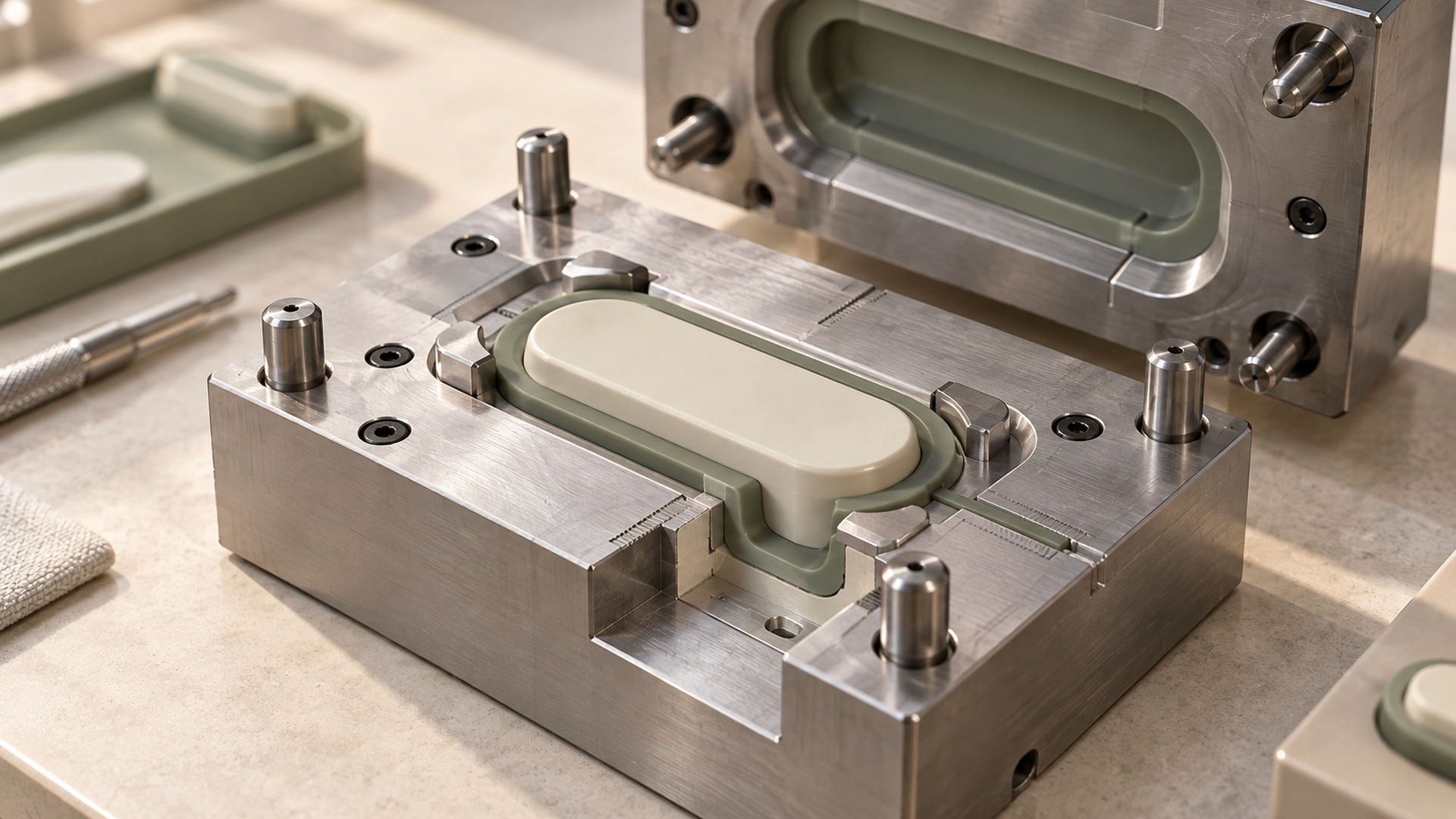
Bonding is not controlled by chemistry alone; the molding process determines how the interface develops. Variables include insert temperature, mold temperature, cure time, injection conditions, local venting, insert location, support against deformation and demolding sequence.
A plastic insert may be chemically compatible with the LSR and still deform if the thermal or mechanical load in the mold is not controlled. A metal insert may stay dimensionally stable but create heat-transfer, edge-effect or ejection challenges. The mold should be designed around both materials: review retention and support features for inserts that can move during injection, and note that for very thin silicone sections, venting and fill balance become as important as adhesion.
Peel, Tear, Lap-Shear and Part-Level Tests
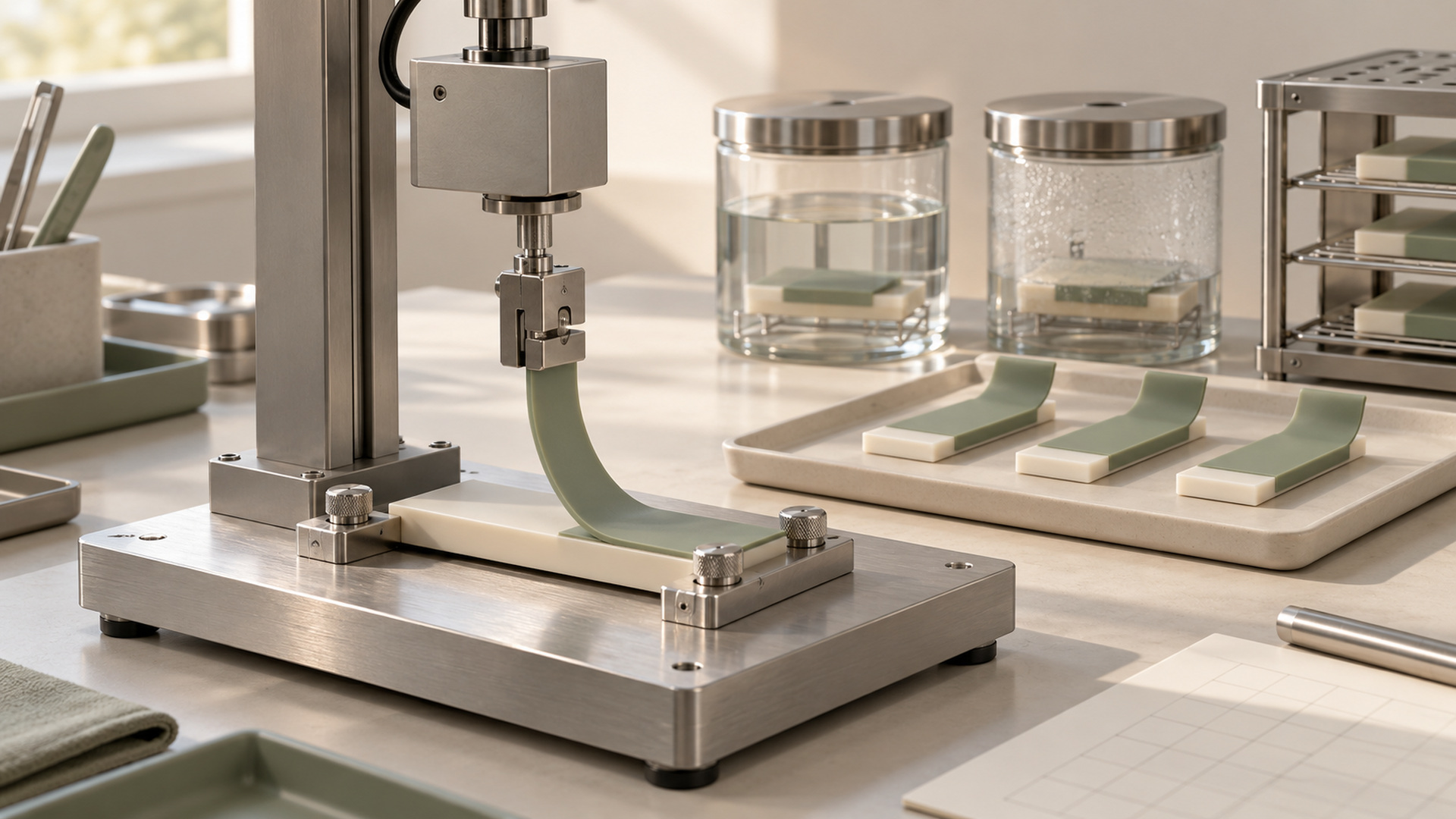
There is no single bond-strength test that answers every overmolding question. The test should match the expected failure mode:
- Peel-style testing — useful where the interface may experience edge lifting or progressive separation.
- Pull or tear-style testing — useful where the molded silicone feature is loaded away from the substrate.
- Lap-shear-style testing — helps compare material combinations under controlled test geometry.
- Part-level testing — often the most important step.
The finished component can fail differently from a laboratory plaque because the real geometry adds stress concentration, curved surfaces, thin edges, assembly preload, cyclic flexing, cleaning exposure and temperature gradients. Material plaques are useful for screening; part-level validation is necessary when the final geometry changes the failure mode.
Heat, Humidity, Cleaning and Sterilization Aging
A bond that passes immediately after molding may not behave the same after aging. Depending on the use case, validation may include elevated temperature, humidity, water, detergents, oils, food simulants, skin oils, sweat, repeated cleaning, thermal cycling and sterilization processes.
Do not apply all of these tests to every product. Choose the environment that reflects actual use: a kitchen component and a wearable component may share the same material pair but need completely different aging plans. The question is what happens to the interface after the product has been used, cleaned and stored the way the customer actually expects.
Food, Skin and Infant Applications: Documentation Boundaries
A raw-material compliance statement is not the same as finished-product compliance. For food-contact, infant or extended skin-contact applications, separate raw LSR documentation, pigment documentation, substrate documentation, adhesive or coating documentation, final component testing, and finished-product requirements.
WACKER's material information for certain LSR grades states specific food-contact suitability under defined conditions. That evidence applies to the stated material and conditions. It does not automatically cover every color, every rigid substrate, every insert coating, printed decoration, adhesive, or the finished consumer product.
For medical or skin-contact applications, the same principle applies: a supplier may provide a material designed for medical use or tested to selected biological-evaluation requirements, but the final device still needs a product-specific compliance strategy. Do not turn a material data sheet into a finished-product certificate.
When Removing Postcure Improves the Business Case
Removing a process step can matter commercially. A separate postcure operation may require oven capacity, energy, labor, handling, work-in-process inventory, floor space, scheduling, and additional inspection or segregation. For a high-volume hard–soft component, eliminating postcure can simplify production.
But the business case should include more than the missing oven step. Ask whether the new material changes raw-material cost, cycle time, scrap rate, mold maintenance, insert handling, color options, supplier availability, validation cost and compliance documentation. A more expensive LSR can still reduce total cost if it removes secondary operations and improves automation. The opposite is also true: if the new material requires tighter substrate control or creates a more sensitive process window, the savings may be smaller than expected. Evaluate total process cost, not only material price.
Change Control for Material and Substrate Suppliers
Self-adhesive hard–soft systems make supplier changes more important, not less. If adhesion depends on the exact LSR and substrate surface chemistry, changes to either side can affect the interface.
A useful change-control list covers LSR grade and supplier, substrate resin grade and supplier, filler percentage, pigment, release agent, plating or coating, insert cleaning process, mold surface, and molding process window. Not every change requires complete requalification, but the engineering team should decide which changes are significant before procurement makes substitutions. The approved BOM should include more detail than "silicone + PBT."
What to Include in a Hard–Soft LSR RFQ
A useful RFQ for self-adhesive LSR overmolding should include:
- CAD and 2D drawing;
- intended LSR grade, if known;
- exact substrate grade and supplier;
- insert geometry, surface treatment or coating;
- required color, expected order quantity and annual forecast;
- required bond function and expected use environment;
- cleaning method and temperature exposure;
- food, infant, skin-contact or medical context, and required compliance documents;
- acceptance method;
- whether mechanical retention can be added;
- whether postcure removal is a project objective;
- change-control expectations.
If the material pair has not yet been selected, ask for a development plan rather than a final bond-strength promise: candidate LSR grades, candidate substrate grades, initial adhesion screening, molded part trials, aging or use-condition validation, and acceptance criteria before mass production.
Postcure-Free Is a Process Option, Not a Reliability Shortcut
The value of newer self-adhesive LSR systems is real. For suitable material pairs and applications, they can simplify hard–soft molding and potentially remove primer application or thermal postcure steps. But the reliability of the finished component still depends on the complete system:
LSR grade + substrate grade + surface condition + chemical adhesion + mechanical design + molding process + aging environment + change control
A material supplier can state what a grade is designed to do. The product-development team still has to prove that the chosen combination works in the actual component.
Technical References
The external companies and product families below are technical references. They are not ESKY SUPPLY projects.
- WACKER — Solid and Liquid Silicone Rubber Product Overview
- WACKER — ELASTOSIL® LR 3671 Technical Data
- WACKER — ELASTOSIL® LR 3675 Technical Data
- Nordmann / WACKER — ELASTOSIL® LR 5471 Announcement
- WACKER — ELASTOSIL® LR 3004/40 Product Information
- WACKER — ELASTOSIL® LR 3005/60 Product Information
- KEAN — Silicone Overmolding for Consumer Products
Material compatibility, regulatory suitability and postcure requirements are grade-specific. Verify the latest TDS, regulatory documentation and the actual material pair before commercial production.