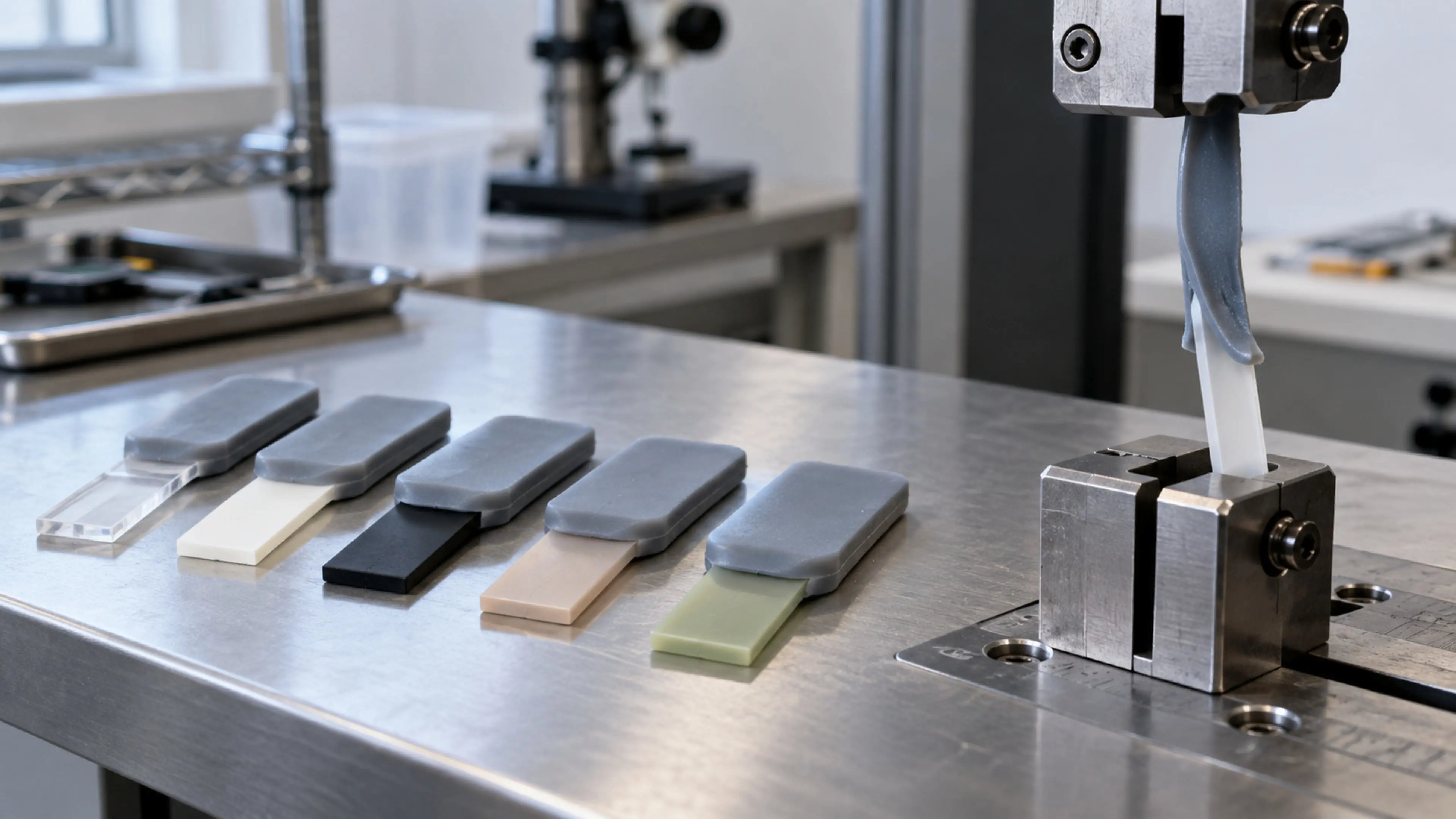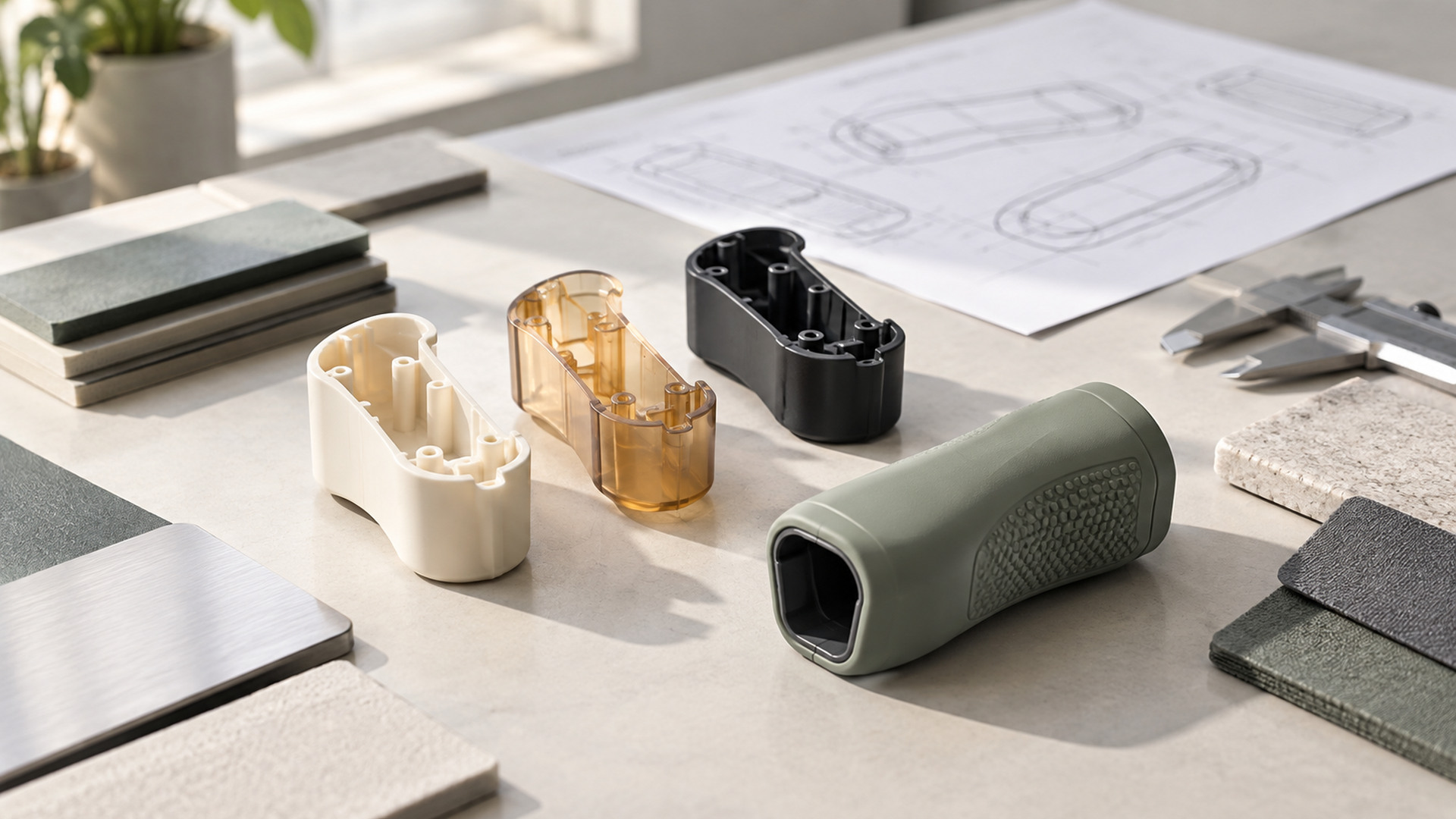
Which plastics are suitable for silicone overmolding, and which need extra validation?
"Suitable for overmolding silicone" is not a property of a plastic family — it is a property of a specific resin grade, its fillers, its surface condition and the molding temperature it sees. Two different glass-filled nylons can behave completely differently under LSR overmolding, and a generic answer that says "ABS works" will not survive contact with a flame-retardant, recycled or UV-stabilized grade.
The practical question for product teams is checking the exact resin grade rather than relying on the plastic family name on the drawing.
Why the family name is not enough
A silicone-to-plastic bond depends on:
- Whether the plastic can survive the thermal cycle of molding without distorting or outgassing.
- Whether the surface accepts the primer or bonds through a mechanical undercut.
- Whether fillers, release agents, coatings or mold sprays interfere with adhesion.
- Whether the plastic stores moisture that boils off during molding and ruins the bond.
Two grades in the same family can differ in every one of these.
Plastics that generally tolerate overmolding
Certain engineering thermoplastics are commonly used as overmold inserts because they retain dimensional stability at the temperatures involved and bond acceptably with standard primer systems:
- Glass-filled nylons (PA6, PA66) — widely used for structural inserts, but moisture conditioning matters.
- Polycarbonate (PC) — rigid, dimensionally stable, common in housings.
- PC/ABS blends — used when toughness and flow are both needed.
- Certain PBT and PET grades — common in electrical and connector applications.
These are general starting points, not approvals. Each still needs a trial with the actual grade.
Plastics that need extra validation
The following categories require explicit trials before tooling is committed:
- Low-surface-energy polyolefins (polypropylene, polyethylene) — they do not naturally bond to silicone and need surface treatment or aggressive mechanical interlocks.
- Highly filled or flame-retardant grades — fillers and FR additives can interfere with primer adhesion.
- Recycled or post-consumer resins — inconsistent surface chemistry.
- Plastics with painted, coated or textured surfaces — the bond may fail at the coating interface rather than the plastic.
- Heat-sensitive or low-CTI resins — they may distort during the silicone cure cycle.
The rule is simple: if the grade is not a well-documented overmolding insert grade, plan a trial before cutting steel.
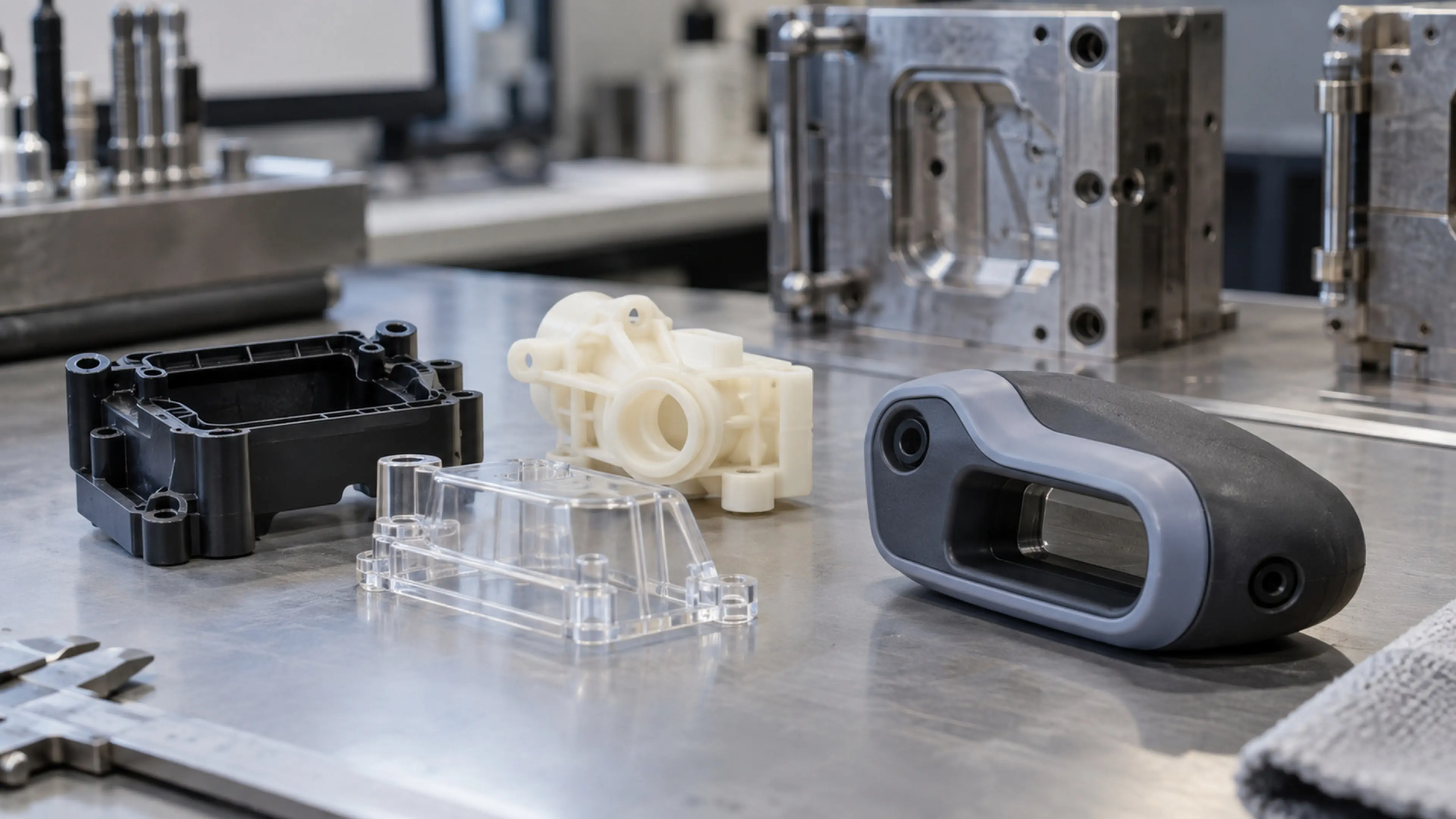
Key variables that control the result
Regardless of plastic family, the following determine whether the bond holds:
- Exact resin grade and any filler, coating or surface treatment.
- Primer system matched to the substrate.
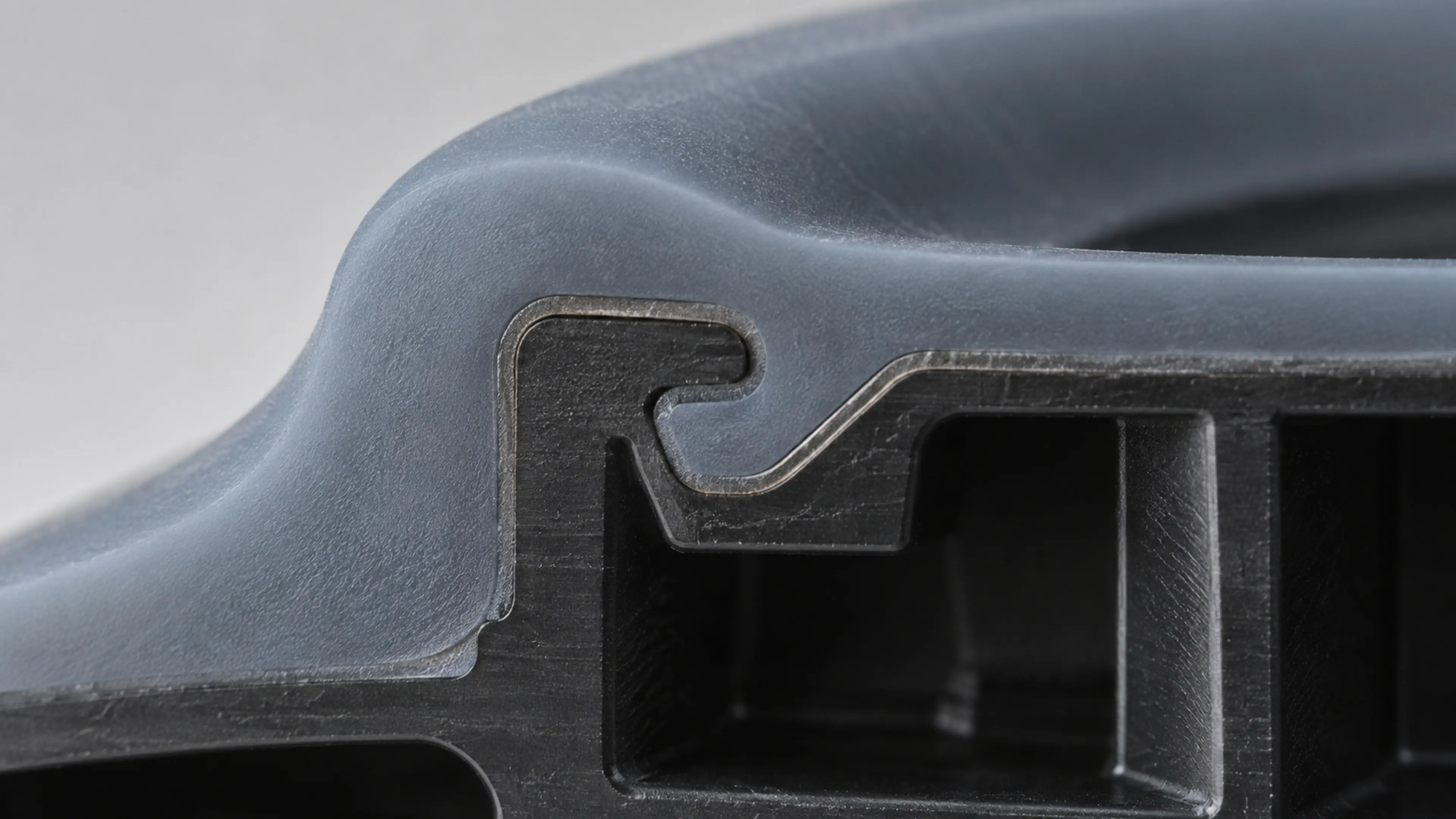
- Mechanical interlock geometry (undercuts, through-holes, knurling).
- Insert support and thermal exposure during molding.
- Surface contamination from release agents, fingerprints or storage.
- Aging conditions: heat, moisture, cleaners, oils, flexing.
Two checks deserve emphasis:
- Specify the exact resin grade and surface condition on the drawing.
- Where risk is high, combine chemical adhesion with a mechanical interlock so the joint does not rely on one mechanism.
Turn the requirement into an acceptance test
"Good bond" is not a criterion. Convert it into:
- A controlled reference — an approved overmolded assembly.
- Critical characteristics — peel or pull-off force at the interface.
- A test condition — as-molded, after thermal cycling, after cleaning, after flexing.
- An acceptance rule — cohesive failure in silicone preferred; adhesive failure at the interface rejected.
- A revision record — which resin lot, primer batch and mold cycle the approval covers.
Compare options by trade-off
When a plastic grade is borderline, the alternatives are: switch to a known overmoldable grade, add a surface treatment, add a mechanical interlock, or validate the grade with a trial. Compare them on tooling cost, assembly labor, rework risk and compliance impact. A known grade is almost always cheaper than a validation program.
Validate before production
Test representative assemblies under the real failure modes — edge peel, thermal cycling, flexing, swelling. A fresh pull test on a good sample does not prove the bond survives the product's life.
What to prepare before the RFQ
- The exact resin grade (or a shortlist) and any data sheet available.
- Whether the plastic part is supplied by you or molded by the same supplier.
- Whether the surface is painted, textured, coated or untreated.
- The expected overmolding process (LSR injection or HCR compression).
- The environment the finished assembly will see.
- Target volume and launch timing.
If the grade is still under selection, ask the supplier to recommend insert grades that suit the bond requirement.
Questions to ask the supplier
- Which plastic grades have you overmolded with this silicone before?
- Do you recommend a trial insert grade, or can you run a coupon trial with our resin?
- What surface preparation or primer is required?
- How do you prevent insert distortion during molding?
- How is bond strength verified in production?
Generic "we overmold all plastics" answers should be treated as unproven.
Conclusion
Choosing a plastic for silicone overmolding starts with the exact grade on the drawing, not the family name. Engineering thermoplastics like glass-filled nylon, PC and PC/ABS are common starting points; polyolefins, filled grades and coated surfaces need trials. Validate the bond on representative samples under aging conditions, and back the chemical bond with a mechanical interlock wherever the joint is load-bearing.